

The Forgotten Poetry on Japanese Pen Cases
On what we carry and what carries us

They are worse than fountain pens for me.
The one that seems to scratch the pen storage itch perfectly is always that next one.
I meant what I said when I commented on Bryant’s note. I’ve just about culled all stationery collections to the essentials, with one exception.
I’ve since gathered every pen case in my possession around the house. It’s as if they were coming out of the woodwork: inside drawers, closets, and bags.
I am a bit beside myself. Surprised at my own sentimentality, my reluctance to declutter, and how such a mundane object had accompanied me throughout my lifetime. I sat down, recounting the moments each seemingly innocent pen case was calling out for.
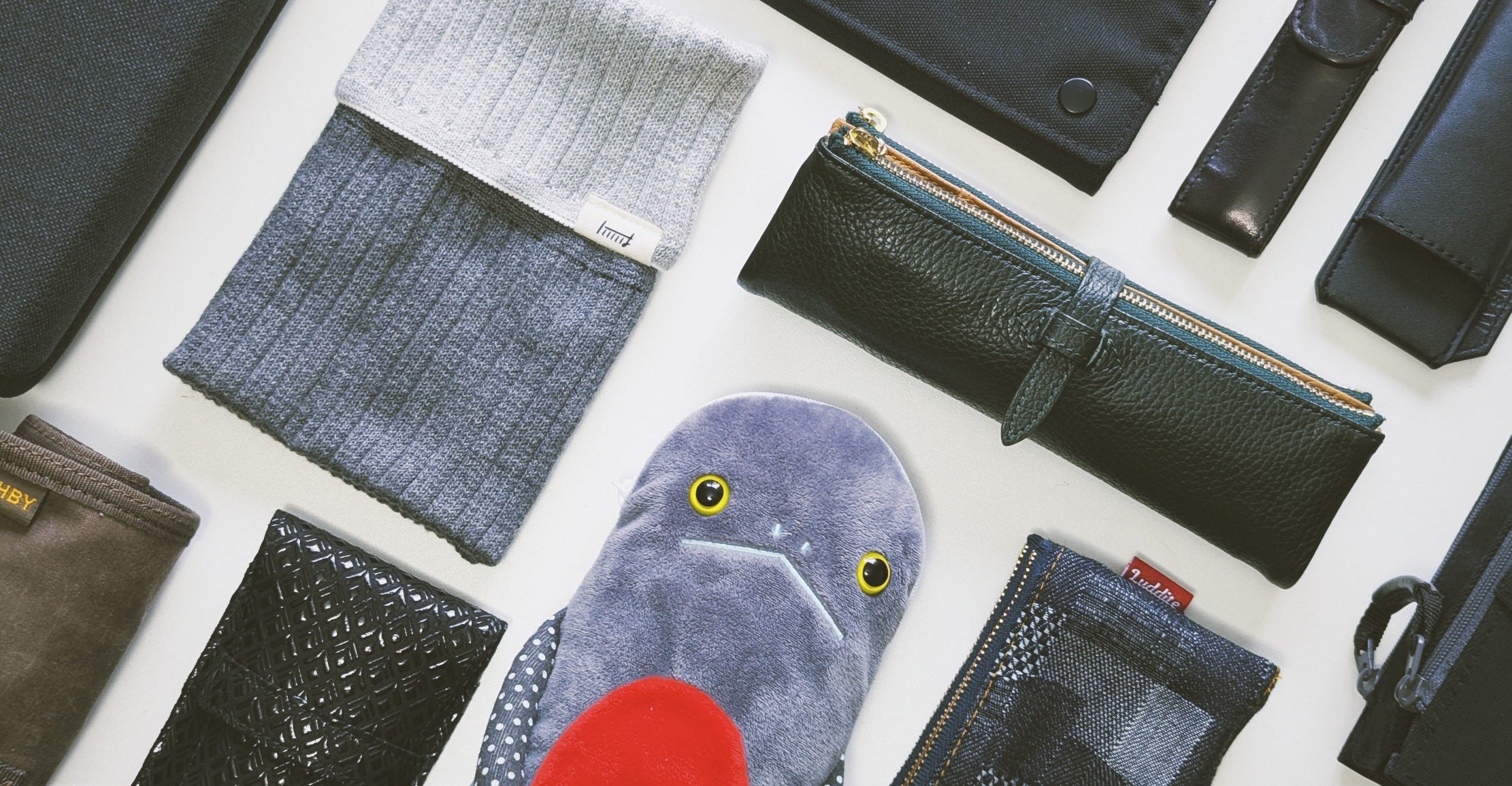
As I lovingly arrange each pen case in these photos, I feel uneasy about my recent pen casing behaviour, and I am not certain why. Each charming pen case held so much promise in organization, protection, and intention. I envisioned how each one would fit into the routines of my life, conveniently forgetting that ideals can never be perfected in practice.
Abundance
There was a time when a new school year didn’t mean that stationery from last semester would self-destruct. I remember navigating envy at a surprisingly young age in the form of these pencil cases: multi-function pen cases from the Showa-era (昭和の多機能筆箱) or fudebako for short.
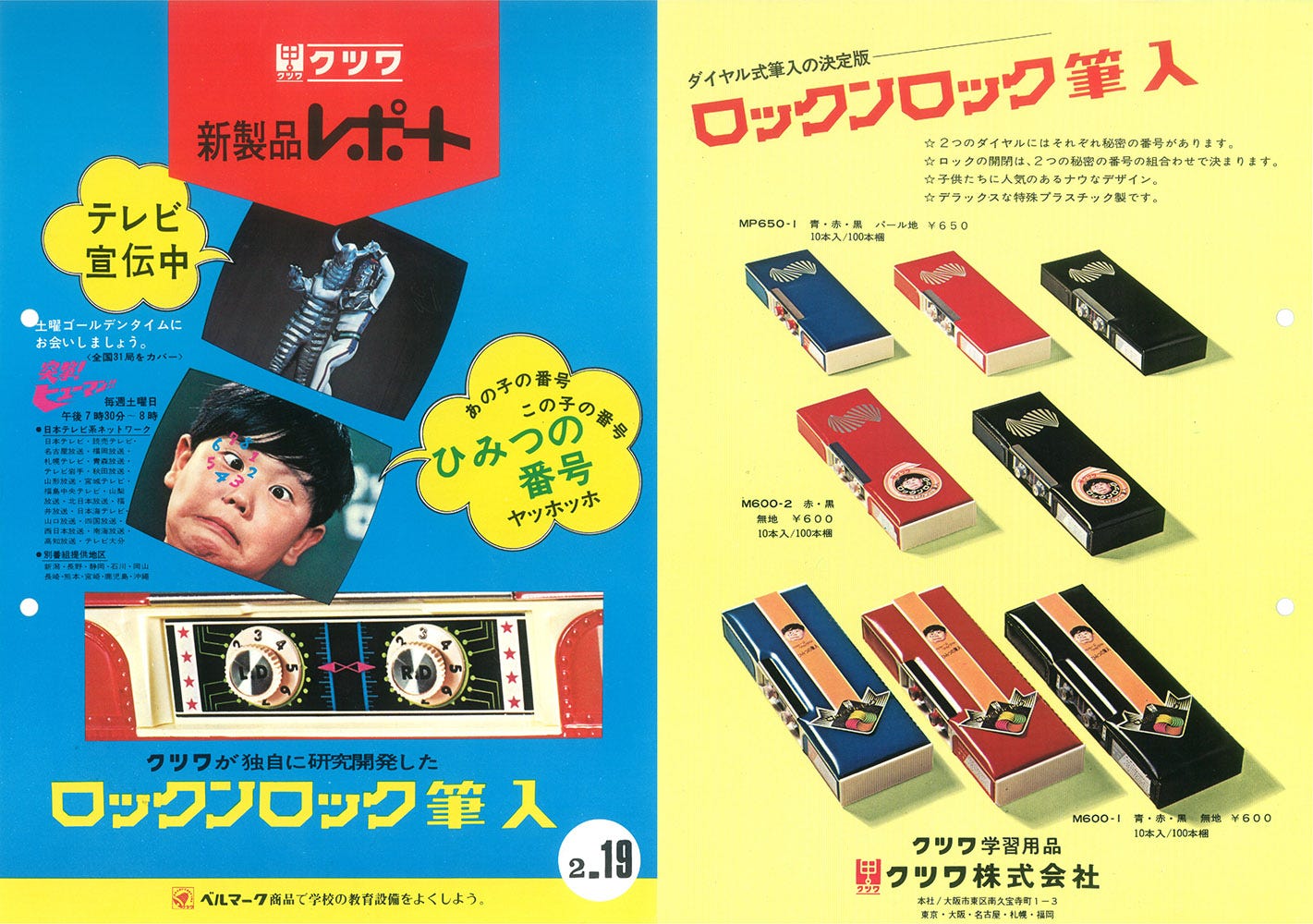
Every student had one. The pen cases of the time had a polycarbonate chassis, double-sided storage, a puffy exterior from the soft PVC vinyl-wrapped foam covers, and self-closing flaps with magnetic clasps.
Features such as, but not limited to, secret compartments, sharpeners, magnifiers, thermometers, staplers, pencil stands, looking like a platform where each writing instrument is ready to launch toward nearby, uncharted desks.


Many of them did not survive the school year, from drops to PVC tearing from the daily grind of living inside overloaded school bags. At our tender age and lacking discipline, we were no match for the allure of the latest designs waiting for us each new school year, with even more doors and gimmicks. Why stop at five compartments when four became the biggest seller this school year?


I had a similar pen case with a majestic-looking JNR C-class train that reminded me of the anime Galaxy Express 999. Instead of a stapler, there was a dedicated sharpener. It was loaded up as suggested, woodcased pencils, a mechanical pencil (probably a Pentel P200), and a Staedtler Mars plastic eraser on the launchpad side, standard issue 3-piece ruler, triangle and protractor on the back. I most likely wrote my name in the clear vinyl sleeve where school schedules would have gone. It had not survived the countless moves halfway across the world. I wonder why pencil case livery for boys was always race cars, motorcycles, and trains?


Kabushiki-Gaisha (now Sonic), Kokuyo, Kutsuwa, Sun-star, Reimei (now Raymay) started with simple two-door pencil cases. Each competed to win the hearts of children through features, ‘door wars’, tactile buttons to unlock secret compartments, and dressed up in the latest manga licensing deals.
Not far away, Flomo in Taiwan was supplying similar pen cases to other parts of the world.
Innocence
It didn’t take long for too much of a good thing to come crashing down.
Each iteration of these pen cases was more like a toy than an organizer of stationery suitable for a learning environment. They were eventually banned from schools.
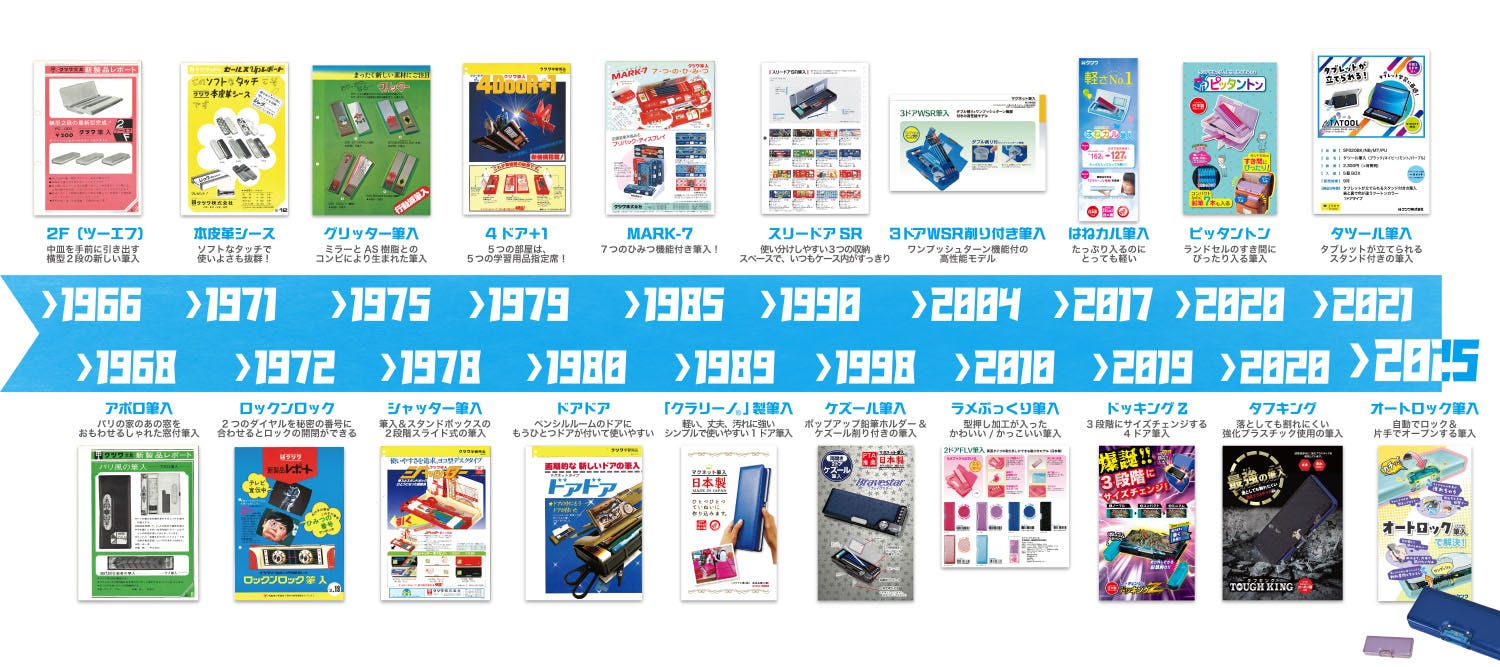
This was a timely change. Many of us were quickly outgrowing our lenticular rulers, robot mecha, and shojo manga with a palette dominated by red and pink with kira kira eyes. This was the advent of the tin pencil case, (缶ペンケース / kan pen keesu.)


Thin, streamlined, with a tray for layered organization. The smaller package was also a canvas for self-expression. Cover designs were prime real estate for Japanese-made English (和製英語 wasei-eigo) and equally popular Sanrio characters or city pop icons. Any negative space became the natural home for Puri-cura stickers (print club photo booth prints) with friends.
These 90s-era pen cases were still made out of steel with a thin layer of tin to manage corrosion. The well-worn ones didn’t simply patina, they would rust instead. While gathering these samples from my family, we each quietly recalled Mitsuru Adachi-style manga moments. The silence of a pen case suspended mid-air in full onomatope and effect line glory. Bowl-cut kids in a circle, spectating on a pair of students, picking up their precious stationery. The start of their first crush.


R-A-M-U-N-E
A white T-shirt and a bottle of soda.
Coppertone on my back.
Summer spent by sea. Sunday.
He’s just another memory
The fragrance of the cologne is bitter orange.
The cove emerald.
Summer spent by sea. Sunday.
I could easily envision the same words in native Japanese. Peak bubble economy in the mid-1980s, the Sun-Star office in Tokyo, a lone writer composing poetry for pen cases with Showa-era melancholy.
There is a reason why this pencil case is in relatively pristine shape. In my own Makoto Shinkai-level recall, this was a parting gift from a middle school crush. Handwritten notes were folded and hidden inside the top cover between classes, only to be unfolded and savoured when anticipation surpassed discipline. This was one of the rare manga-like moments that actually happened in my own timeline. When a secret crush reciprocated.
In the final few months of the school year, she grew distant. Feigning studies and upcoming exams. I later learned that her father was called back to Tokyo for work. I was crushed.
40 years later, ‘He’s just another memory’ reads awfully poetic.
Yuko-san, wherever you are. Thank you for the memories.
Even now, the sound of the glass marble and the taste of Ramune transport me right back to that particular summer.
Intention
Even though I didn’t know the meaning of the word until much later, I recall the feelings of mottainai 勿体ない. Often associated with a sense of pathos when objects are not put to use as intended. It could also be used with humility and respect when something is too precious for use.
Stationery lovers unintentionally swear by this when we hold our prized notebooks that feel too nice for us. It’s also a deeply felt paradox as a journal is both infinite in value for its potential as a masterpiece, yet it’s worthless because of its blank pages.
In my hand is my first fountain pen, given to me by my mother. There appears to be some real depth to the body finish. I learned that Dunhill (Caran D’Ache was the OEM) had expert craftsmen deploy an authentic Chinese lacquer technique. The friction-fitted cap has just about reached end-of-life, where the latches barely hold the lip of the section.


I was at my first job that didn’t involve waiting tables or getting my hands dirty. I was working part-time at a bank. For my mom, it must have felt like the right time for her to pass on her well-used fountain pen. A pen that had accompanied her long before I was born, my first heirloom object.
It’s no surprise that I was instantly converted by the line variation and effortless writing experience. I found myself needing a way to carry the pen when I was not in a suit with shirt pockets. It was too precious for it to be tumbling around any old pen case or my backpack.
Earlier today, I telephoned my mother to try to get more history on the pen. Most of it seemed fuzzy to her. She ended our call by reminding me to enjoy it, and when she’s no longer around, let it be a memento to remember her by.
Escalation
When journaling on the go required more than one pen, I began looking into multi-pen cases, each with its own moments of glory and faults. Since I was carrying extra stationery, I lost sight of intentionality and carried for what-ifs.
Kokuyo Pencase WITHPLUS: For a long time, this simple sleeve was it: quick access to a fountain pen on the outside, essential stationery within.


Lochby Tool roll: Aesthetically correct but spiritually overcommitted. Required more desk space than my journal when unrolled.


Raymay Detecool Vertical Stand: So close, an homage to the humble pen cup. A fatal flaw in my particular use case - fountain pen bouncing around. Case within a case territory.


These were just a few of the cases that I was testing out, as there was a lot of drift in experimenting. It’s clear to me now that I overcarried. From contentment and peace of mind to curiosity and optimization, where the pen case became its own thing rather than being mostly utilitarian. It was a slippery slope. What I needed was simple: only the essentials.
Summit
I was perspiring a bit, even though it’s the middle of winter in Tokyo. A bank of overhead lights ensured the wall of stationery products was well-lit, making it easy for would-be customers to examine potential purchases carefully.


Feeling a sense of awe as I stood in front of the aisles of pen cases, my daughter hesitantly reached for one that was almost the size of her school bag. Five dedicated compartments with the capacity for everything that she would need. Essential writing instruments, a slot on top for her favourite foam eraser. Plenty of room on the right for her sharpener, stickers, techo, and rolls of washi tape. Even I was succumbing to the promise emanating from it. One case to rule them all, both at home and at school, to tackle any school task imaginable. She chose something else instead.
I was in search of a pen case with dedicated pen slots and some general storage for other pens and small stationery. In the 2025 Stationery Show in Japan, the Luddite Bendy Pen Case was awarded the coveted Stationery Award of the Year in Japan. Perhaps I am not alone with my particular use case.


Coppertone on my back. Summer spent by Sea
When I started this piece, I genuinely believed that this was going to be a light commentary on various pen cases. Weeks passed with bouts of profound nostalgia and reveries triggered by a stationery object that I thought little of. I never realized its significance until now.
It’s almost irrelevant that I am writing about stationery. One could substitute coffee grinders, keyboard switches, or stereo equipment. Given enough time, we optimize ourselves into a small store. Somewhere along the way, accumulation becomes the hobby. It stings to realize that I spent years optimizing the hobby instead of doing it. This shift is something I’ve been navigating intimately, having started working with a Henokien-like Japanese crafts business last year.1
Some bygone cases I recalled warmly. Many of the modern pen cases are made out of Teflon/Cordura, and I suspect they may outlive the planet. My current case is the Lupo (ルポ 2 セカンド ペンケース) by C Company Limited. It’s beautiful to me, and it’s the closest object to peak pen case.


I would not be surprised at all if they took a page out of the stationery playbook, announcing upcoming limited editions. Identical in design, but made with mythical Falcore ‘84 hide in limited runs. All of a sudden, doubts would creep in, and my summit case would drift.
It’s interesting to me that at the time of writing in 2026, with all that is happening in the world, designers at stationery shops are still attempting to solve the problem of how we best carry writing instruments, just like our poet at Sun-star in Tokyo, almost half a century ago.
The next time I find myself standing in front of a wall of stationery at InCube or LOFT, I wonder what memories and stories I’ll invoke and try to hold on to and protect.
In this lifelong journey of finding a suitable way of carrying cherished writing tools, I never thought I’d give in to the whims of my children. It may have been something funny at first, but this Mokeke plush ended up being a dedicated pen case for a Pilot Custom Urushi. Call it a clash of aesthetics, an exercise of absurdity with a plush monster resembling an eel (my kids call him unagi-kun), safely housing one of my fanciest fountain pens in my small collection.


I wonder if my daughter’s Mokeke will accompany them for the long haul. If hers doesn’t survive, maybe Unagi-kun will be hers one day to remind her of our adventures, summer vacation by the seaside in her mother’s hometown.
✒
Thank you for reading. The Way of the Mirror is a free and reader-supported publication on the beauty of memory making and journal writing. If you enjoy it, you can support my work with a paid subscription.
Wil
Image Sources
Some of the images in this piece circulate online without any clear attribution. Where sources are identifiable, they are credited. Several images appear to derive from Kutsuwa and Reimei promotional materials or period Japanese magazines whose exact publication details are unverified. If you can identify an original source, please drop me a note.
I have been designing and prototyping various stationery items, including heirloom-quality notebook covers. It is still in the very early stages, and pen cases are currently on a slow burn in the backlog. More on this if and when the prototype arrives.
Wil! This totally brings back memories of my school days. I love those tin pencil cases. I remember my classmate had a bear-shaped version and I had some rectangular one with a penguin cartoon on it. We swapped from time to time, which was fun.
It also brought back memories, around the same time, as my friend and I turned our pencils into “dolls” by tying threads on the top (as hair) that we can braid, and the pencil cases became “homes” for these “dolls”. We had quite an imagination. One way of beating school rules about toys.
Those pencil cases were long gone. I still think about them from time to time. Now I have random pouches from Daiso or a travel toiletries bag as pencil case. Nothing as fun as it used to be anymore.
Wil, this was such a good read dude. You were not joking about being deep into the rabbit hole that is pencil cases haha. Your cases are absolutely beautiful. I appreciate you sharing the stories about your middle school crush and the fountain pen your mother gave you. This was awesome.