

Techo Kaigi, Part 2: System Techo as a Talisman for Everyday Life
On everyday planners, wabi-sabi pens, and the quiet joy of what endures

It was the early 90s, and life was grand for me as a teen. Our city's baseball team was in the pennant race and ultimately won the World Series back-to-back. I had passed my written test and became a "probationary" driver, experiencing the thrill of "speed" with my friend's family Dodge Caravan, faux-wood exterior panelling and all.
I was juggling the responsibilities of a high-school student and flipping burgers at a neighbourhood fast-food restaurant. One evening at the corner Jumbo Video store, I pulled a little-known comedy from the rows of new release VHS from the shelf, a film that would quietly spark my love of planners and notebooks.
Taking Care of Business (1990), or Filofax, follows a free-spirited con man (James Belushi) who assumes the life of an advertising executive (Charles Grodin) after stumbling across his lost Filofax planner. The result is a string of lighthearted mix-ups typical of the comedies of its era. Reviews were lukewarm, as the genre was crowded with bigger and more endearing hits at the time. Curiously, it was the first produced screenplay by a fresh-out-of-college J.J. Abrams, long before he became a household name.


The film, like every other budget comedy of the period, would have faded and been long forgotten except that it didn't. The Filofax planner and its uncanny ability to store a treasure trove of information of the utmost importance opened up a Pandora's box of possibilities. The ringed planner and the promise it holds took on mystical proportions, not only for me but for many others as well.
Mere days later, on our lunch breaks, I convinced a co-worker to cash our pay cheques and we picked out a Daytimer and inserts at a nearby Grand & Toy. The phenomenon had caught on, groups of teens in fast food uniforms would walk around the mall with overstuffed Daytimers, mistaking ourselves as mini-executives, accompanied by an aura of confidence and self-importance that only comes from peak planning: our schedules are recorded, essential phone numbers and birthdays decorated, with bills and bus tickets secretly tucked away in pockets for emergencies.
This is part 2 of an ongoing series on techo kaigi, where I share stories and dive into the details of how I am using some of the wonderful notebooks and stationery pairings that have made their way onto my writing desk. In this essay, I'll be focusing on an everyday carry planner/notebook. If you are new here, check out part 1 for an overview of techo kaigi and my journal universe.
The Return of the Rings
Last year, I attended a group journaling event at a local stationery shop. I had bonded with a fellow journal writer over the same quirky desire: to free up certain pages from completed inserts and carry them with us (more on this below). That small exchange planted a seed, the idea of bringing a small ring planner or simply "rings" back into my life, not unlike the Daytimer I used in my youth.
The Krause rings mechanism promised the ability to curate, rearrange, add, or remove pages at will: this felt like opening Pandora's box all over again. Through my envisioning, the planner doesn’t have to be a bound book with fixed pages; it could be a space that I would shape with the flexibility to carry only what mattered.
Exploring System Techo through Japanese Magazines


I first stumbled across the term system techo (システム手帳) in a library copy of System Techo Style (システム手帳 STYLE), a Japanese magazine dedicated entirely to the format. At the time, my Traveler's Notebook was already dialled in as wallet, calendar, and journal, but going through past issues brought me straight back to the peak planner days of my youth. There was a dizzying array of ringed planners, each with its own trade-offs between portability and writing comfort.
A common question in the community is “which notebook size is best for a particular use?” Traveler's Notebooks have two (Passport and Regular), Hobonichi has three (Weeks, A6, A5). System techos, however, have six standard sizes, and I wouldn't wish the resulting analysis paralysis on even my arch-nemesis; my eyes glazed over just trying to figure out which one to choose.1
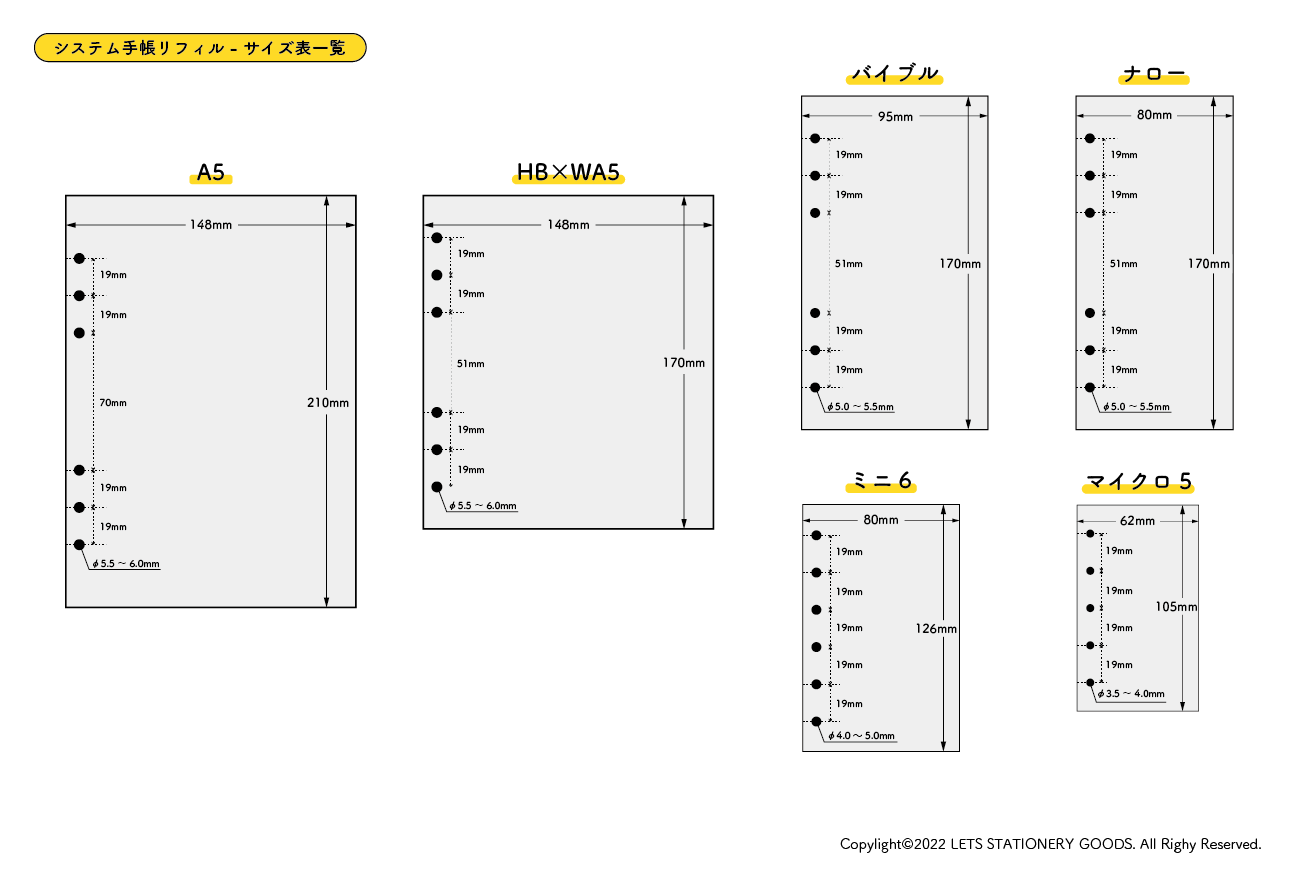
I could empathize with the folks who rage quit when a particular size simply doesn't work. On the other hand, each planner invites some envisioning or tinkering until it settles into a system that simply works. There is a sense of accomplishment when our tools disappear into the background and we are using them uninhibitedly, almost as an extension of ourselves.
The Stationery


KNOX Mini6 System Notebook in JAPAN BLUE
システム手帳 ミニサイズ ジャパンブルー
Size: Mini6, Inserts: 80mm x 126mm, Rings: 15mm, Interior pockets: 3, Pen Storage: Loop, Closure: Band and Loop
I took a chance and found this KNOX system techo on Mercari Japan.
At the time of order, I was not all that familiar with the nuances or what to look for in a system techo other than its size. Thankfully, the planner arrived in pristine condition and everything worked out.
The ring diameter is 15mm, which sits near the middle of the spectrum in Japanese system techos (8, 11, 13, 15, 19 and 25mm). This is another instance of the same usability and portability trade-off. The smaller the rings, the narrower the spine for improved carry comfort, but at a cost of not being able to hold as many pages. Depending on the inserts used, expect to max out at 100 pages in a 15mm diameter ring before page flips become more difficult.
Different manufacturers have different philosophies on this. PLOTTER has adopted a minimalist approach, prioritizing portability by imploring its customers to carry just the essentials. They have opted for a narrow 11mm diameter ring across most, if not all, of their notebook sizes. This is the opposite of Filofax, where rings are in the 19, 23, 25, 30 and even 38mm range. We are in the spine thickness territory of dictionaries, textbooks or phone books of small cities.
Other considerations for a system techo are pen and accessory storage and the cover's fastening closure. In the model that I picked, there is a robust pen loop with a large enough diameter to hold a Pilot Vanishing Point securely and comfortably. The simple band and loop closure also helps with keeping the pen snug. When writing, the loop can be folded down and out of the way. After using this for some time, I have come to love and expect a secure and robust pen storage for at least one pen with any pocket notebook.2
A sidebar on “JAPAN BLUE” and colour naming in Japan
Fountain pen friends familiar with Japanese inks may already be alerted to this: in Japan, colours are not just descriptive but named, codified, and given poetic associations drawn from nature, seasons, flowers, and even emotions. This tradition dates back to the Heian court (794–1185), where layered kimono colours symbolized seasonal changes and refined taste.
Aizome (藍染め), Japanese indigo dyeing, transforms natural indigo leaves into deep, shifting blues through repeated dipping, a centuries-old craft admired for beauty, durability, and subtlety. Once common in samurai garments and work clothes, it lives on today in artisanal fashion, boro patchwork, and sustainable textiles.


The folks at KNOX seem especially proud of their Japan Blue lineup. There is plenty of context on their craft and process for those interested.
PLOTTER inserts
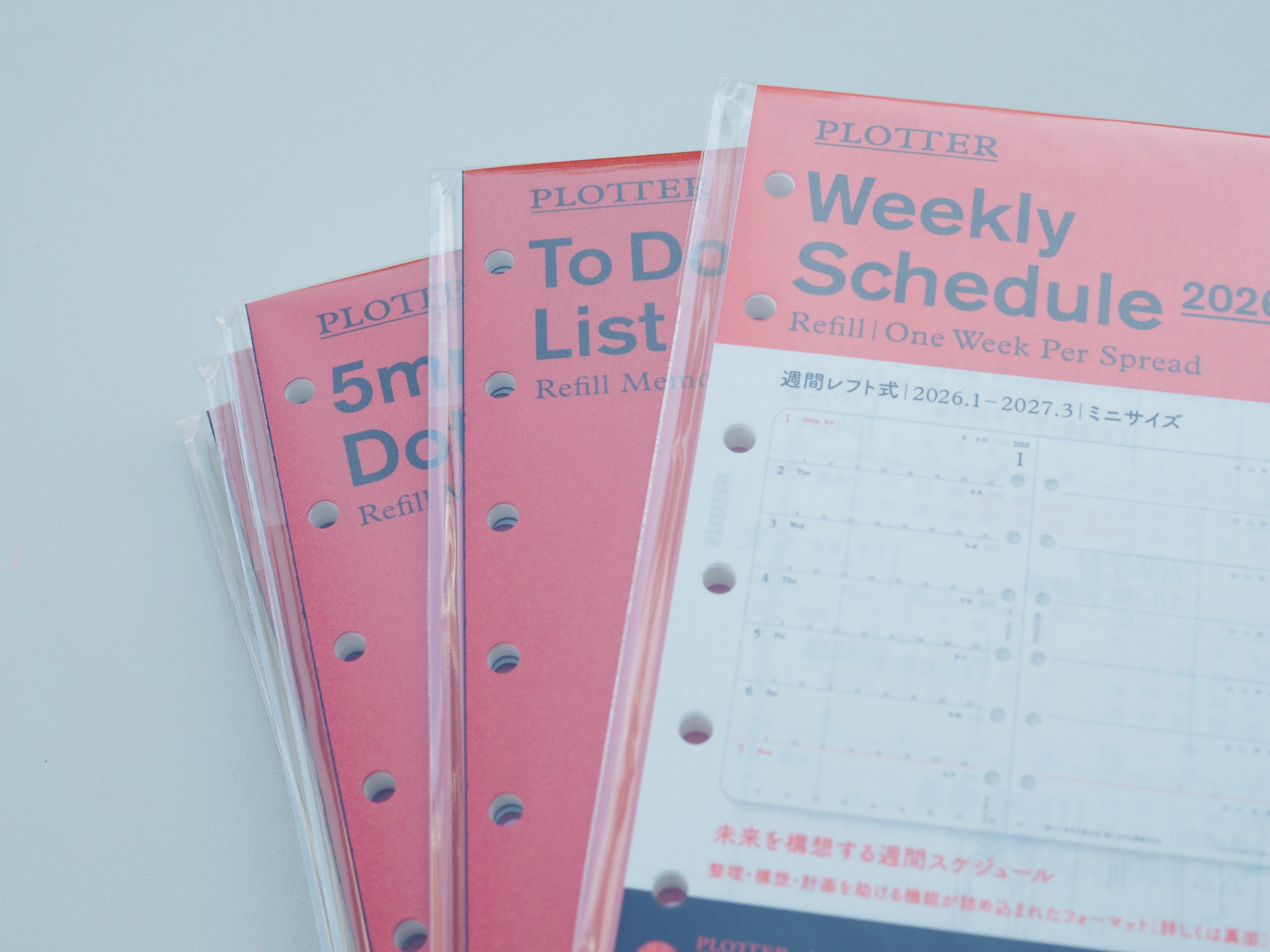
PLOTTER seems to be the most accessible planner insert in North America. Knowing that Design Phil is the parent company behind Midori, Traveler's, PLOTTER and KNOX, I was confident that I would have no problems with the quality of the paper while also being fountain pen friendly.
Pilot Vanishing Point - Matte Black [M]
Since the release of this particular model of the Vanishing Point (VP) in 2013, it has been a daily pocket carry. There are plenty of battle scars from daily use, cycles in the washer, and nib replacements. The matte finish has been polished to a smooth surface, and each blemish carries its own stories, memories, and milestones: from moments of celebration of signing documents at the hospital when our children were born, to serving as a quiet fidget companion through fraught one-on-one conversations in my past life in the corporate world.
At the time of its release, there was a bit of drama about the lack of durability of this matte black finish. All of the other VPs at the time had the same glossy and robust lacquer over brass, which held up very well over time. Folks on forums were complaining to Pilot about how easily the matte black finish would scratch and chip, demanding a refund.
More than a decade later, I'd like to believe this design "flaw" is a hidden feature to accentuate the beauty and fleeting nature of our well-worn and much-loved tools. If there was ever a design principle to help combat over-consumption culture, it would be this: wabi-sabi, well-worn, patina aesthetic, where products improve with age over time. I genuinely wish more products were designed with longevity in mind.


For the non-fountain pen nerds, the claim to fame of the aptly named Vanishing Point (Capless in the rest of the world) is that, unlike its peers, the click mechanism offers the convenience of quick deployment and retraction of the nib, much like the ballpoint pens or mechanical pencils. Other fountain pens are generally "slower", requiring intentionality and two hands to rotate or pull the cap off the body of the pen before a writing session. Because of this particular design principle, the VP is often touted and recommended as the fountain pen for everyday carry to go alongside pocket notebooks.
How I am using it:
As I mentioned before, the KNOX system techo replaced a Traveler's Notebook. It is with me almost all the time and serves as a wallet, calendar, light Bullet Journal (BuJo), pocket notebook, and a mini museum. Let's explore each use case in detail.
As a Wallet: identification, fiat, and bank cards are found in the inside pockets. Frequently used passes and cards are punched and sit in the opening pages for ease of access.
As a Calendar: I carry about 2-3 months out. Time and date-sensitive appointments go on the left, and notes are on the right.
As a Bullet Journal: a ringed system really shines for BuJo. I was never a fan of indexes and page numbers. I enjoy carrying only the handful of pages that I need to refer to when I am out:
Daily log for busier days
Weekly tasklist
Monthly Expense Tracker
Collections: Projects, Distractions, Procrastination, Highlights from book 1: current obsessions, principles, reflections.
Just like the Traveler's Notebook, there is a camp for in-cover writing, while some prefer to take the notebook (or pages in this case) out before writing so that the spine doesn’t get in the way or the pages lay flat.


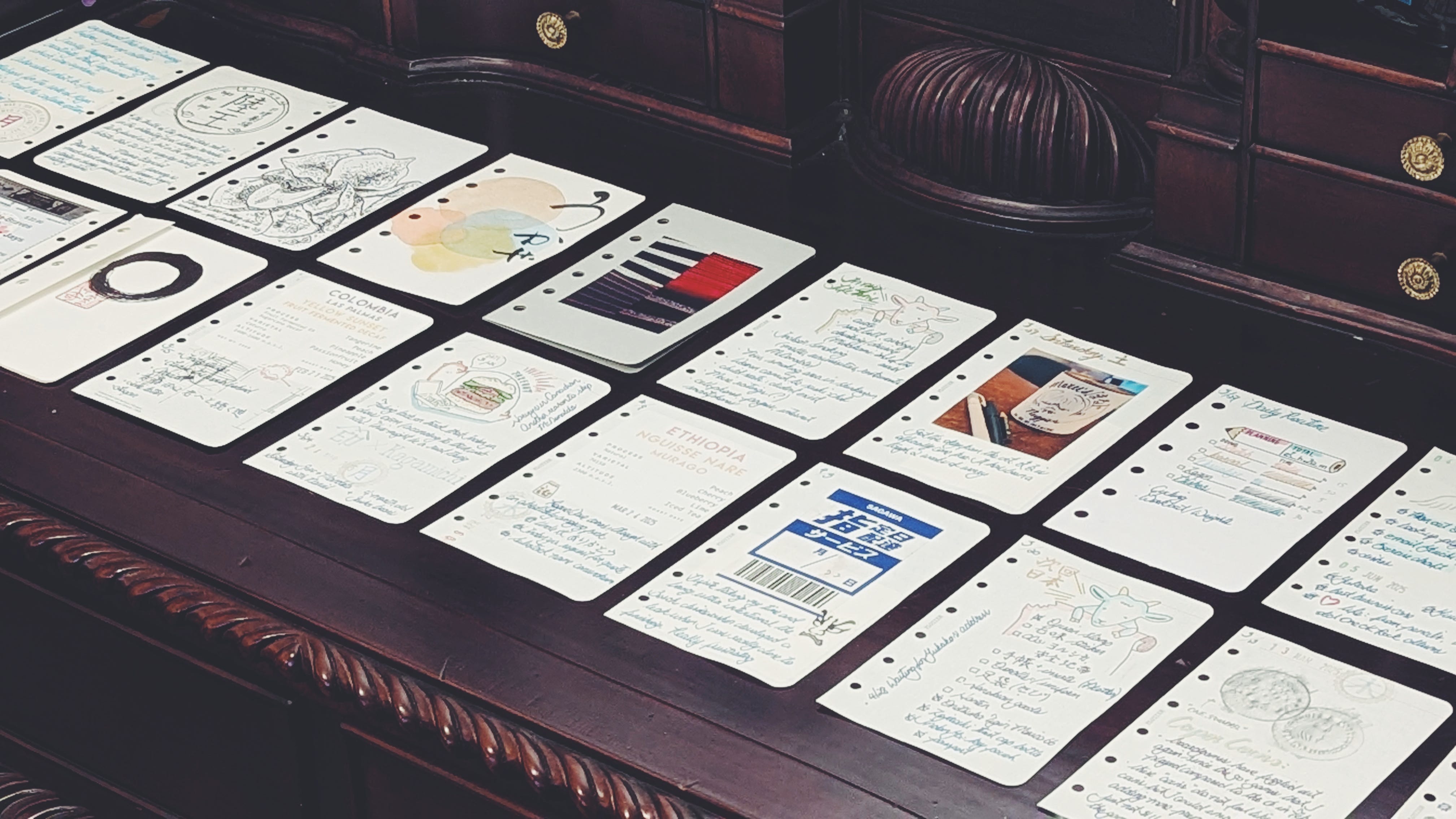
As a tiny museum of past entries/artwork: With a 6-hole punch, a sharp knife, and an optional rounded-corner punch, just about any paper, ticket, maps, or pamphlet can be transformed into a page for the system techo without the need for glue or washi. It had been a long time since I last used a binder, and it took me a while to fully appreciate the flexibility and utility of this.
In my daily writing ritual, I sometimes refer back to old entries. In many of these sessions, I often surprise myself when I relive the full impact of reacquainting myself with forgotten milestones, memories, obsessions, or even simple doodles. Given the flexibility of the rings system, just about anything flat could be punched and folded to fit into the system techo. It becomes a mini-curated gallery of key moments from past journals that is always in my pocket, serving as a source of inspiration or meaning. Pages that were once locked in past notebooks can be freed, making an occasional appearance again or archived when it's time to rotate them out.
What's working well:
In a way, the switch from a Traveler's Notebook to a system techo began as a hypothesis. Does the benefit of flexibility to curate pages outweigh some of the disadvantages of more bulk and complexity in an everyday carry planner/notebook? In my use case, it's a resounding "yes" on all accounts.
Since using a system techo from the beginning of the year, the flexibility of rings enhances the benefits of a pocket planner/notebook.
Even before the switch, I loved carrying a planner every day. The system techo deepens the joy I find in simple tools that bring quiet contentment:
Lightening the mind for clarity: Over the course of any day, we have up to 6,200 thoughts3. Cognitive offloading to a notebook helps me clear mental clutter and make space for focus. When I review the daily log at the end of the day, most items end up being noise, but occasionally, an item worth unpacking sits there in waiting. I'd hate to forget that one hard-earned spark of inspiration, insight, or idea simply because I moved on and forgot to jot it down. Since I started daily logging, a pocket notebook/pen has been indispensable.
Creating order: In a world where we may have much less control than we'd like to believe, envisioning and planning bring a gentle structure to make the day flow more smoothly. This may be one of the reasons why BuJo and analogue planning continue to thrive in a world of devices and apps. It's one of the few opportunities where we can look towards the future with a bit of hope, optimism, and curiosity.
Aesthetic and craft satisfaction: the tactile and visual qualities of planners appeal to our innate love for beauty and art. Taking the time to transform mundane lists in a way that speaks to us visually is an opportunity for a creative ritual. Realizing that I was no longer bound by an entire book of an insert and I could create one-off accordion fold-outs or watercolour-friendly stock to fit inside a system techo was a moment of creative liberation. I am always on the lookout for novel ways to craft and DIY interesting inserts.
Strategy as play: as a gamer dabbling in both boardgames and digital, I believe one of the greatest joys of gaming comes from devising a path to victory based on conditions dictated by the board and other players, executing this plan, and making adjustments along the way to realize a vision. In a way, the use of planners and specific BuJo collections has a lot of crossovers with being strategic in life: mapping out time and energy as resources, min/maxing priorities before making a decision and executing. Crossing off tasks and goals means arriving at the destination that we mindfully envisioned for ourselves, bringing a satisfying closure in our own game of life.
A ritual of mindful moments: every time I open up the system techo, is an opportunity to feel grounded, and this small repeated act brings order and mindfulness to inhabit the moment.
Leaving a trace: When I look back at past planners, there are a lot of inconsequential and mundane tasks that are probably meaningless: Laundry day, groceries, health appointments. However, buried in the mundane are clues and context that may contribute to meaning later for others. I often ponder if my kids will ever flip through an old Hobonichi Weeks and piece together the context of what my partners and I were doing in preparation to welcoming them into our lives (more ultrasound appointments with washi-taped thermal printouts).
A touchstone of memory: words, photos and small keepsakes from past journals that make their way back into the system techo acts like a powerful comfort object. They act as a gentle reminder of challenges met, moments cherished, giving quiet strength at times of need.
Our Well-Worn Tools as Talismans
In a recent issue of システム手帳 STYLE, a longtime Filofax user shared how, on a business trip to Milan, he discovered a bible-sized Il Bisonte planner. Twenty years later, he still treasures that same well-worn system techo. Through the magazine's endearing pull quotes and photos, I could almost feel the quiet contentment radiating from his companion of decades.
The industry will consistently churn, pushing new formats and promising greater beauty or fulfillment. Trends will rise and fade, each demanding more attention than the last. But I want to resist — steadying myself in the middle way, free from distraction, loyal to the companions I've already chosen.
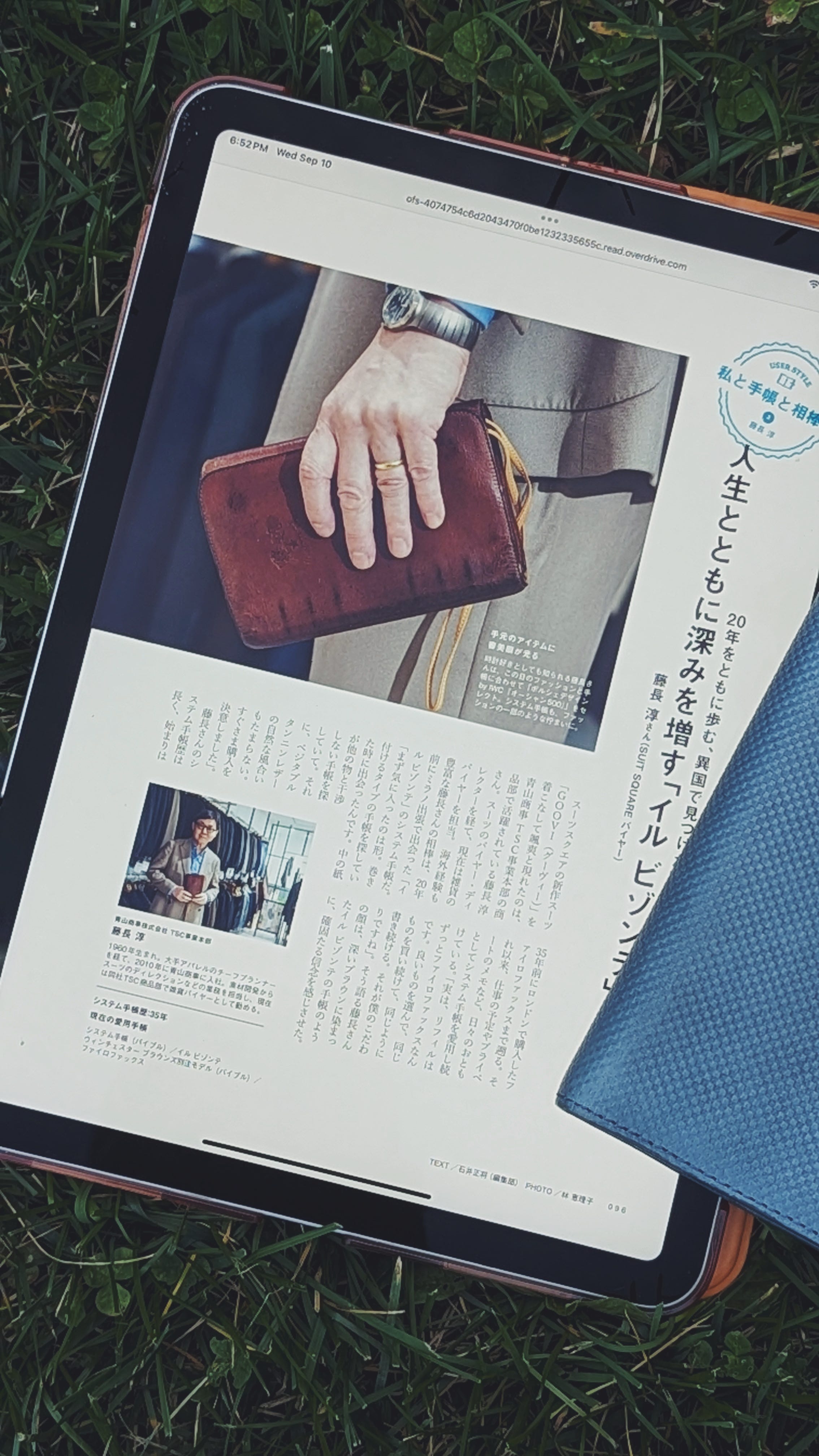
Like the Il Bisonte planner, my own system techo and pen are more than tools. Page by page, mark by mark, they will age and navigate life with me, guiding me like a talisman: not of luck, but of companionship and time.
The Way of the Mirror is a passion project that brings together journal writers. I value transparency and journaling nerdism, from the tools I use to the steps in my writing process.4 If this reflection sparked a moment of inspiration or introspection, consider supporting this work by subscribing. It truly means more than you know. Thank you for reading.
Wil
Journal Exercise Prompt:
There is no writing exercise this week. I was surprised by how verbose I was about system techos and pocket notebooks. I do want to leave a short prompt for my readers:
If you could easily curate entries from past journals and have them with you, what entries or moments would you want to carry and why?
Among the many sizes, A5, Bible, and Mini6 have the widest variety of inserts to choose from. While the esoteric HBxWA5 (Height of Bible x Width of A5), Narrow and Micro5 seem to cater to niche enthusiasts. For some, the appeal lies in simplicity: a single Bible-size planner that balances desk use with portability. Others pair an A5 at home with a Micro5 on the go. Since ring spacing is standardized, inserts can often be swapped across formats with minimal adjustments.
Every issue of システム手帳 STYLE includes 1:1 specs of various-sized techos with details on rings compatibility.
There are some really well-thought-out designs, such as pockets to hold a separate pen sleeve, stitched-in magnets for a minimalist cover that's also convenient to open and close.


Julie R. Tseng and Jordan A. Poppenk, "Brain Meta-State Transitions Demarcate Thoughts across Task Contexts Exposing the Stream of Consciousness," Nature Communications 11, no. 1 (2020): 3480, https://doi.org/10.1038/s41467-020-17255-9. The authors write: "Extrapolating from our observed median transition rate across movie-viewing and rest of about 6.5 transitions/min, and a recommended sleep time of 8 h, one could estimate over six thousand daily thoughts for healthy adults of a young-adult demographic similar to the one used in our analysis."
Ideation: A Blackwing Pearl with 2025 Hobonichi HON · Initial Draft: Joplin · Editing: Grammarly · Photos: Pixel 7 and Olympus OM-D E-M5 Mark II, M.ZUIKO 25MM F1.8, VSCO · Magazines mentioned were accessed from my local library.