

Field Notes from a Designer Failing at Design
On Woodblock Prints, Wagara, and Anonymous Beauty

I searched for months.
Just about every waking moment, I was always on the lookout for inspiration. Even during moments of idleness, motifs inspired by nature and patterns lurked in the back of my mind.
I studied, mimicked, and sketched through countless cycles of exploration, excitement and ultimately disappointment. Doodles were peppered throughout planners, journals, napkins, and children’s homework. Each new attempt and iteration either felt off, lacking in meaning and elegance that usually shows up in the form of a particular feeling in the gut.
Last year, I had an opportunity of a lifetime. After having written and uncovered how much respect and curiosity I had for craft-centred, Henokien family-owned businesses, I reached out to one.
Against all odds, they responded.
I dusted off the sewing machine and found myself putting together prototypes for stationery products. The idea of combining modern everyday stationery objects with century-old heirloom-quality craftsmanship that wouldn’t have otherwise existed was a bit intoxicating. In order to realize this vision, I was to design a wagara pattern.
Spoiler alert. Failure by definition should be disappointing. At the time of writing, I have yet to achieve what I had set out to do. Timelines for a prototype have long passed. Yet I am hopeful.
In hindsight, this is one of the most satisfying failures of a project that I had taken on. But this wasn’t always the case; it was only after a 6-week trip to Japan, where I wasn’t necessarily looking for answers but for inspiration and clues, that I had uncovered where I had gone wrong.
This essay is my field notes.
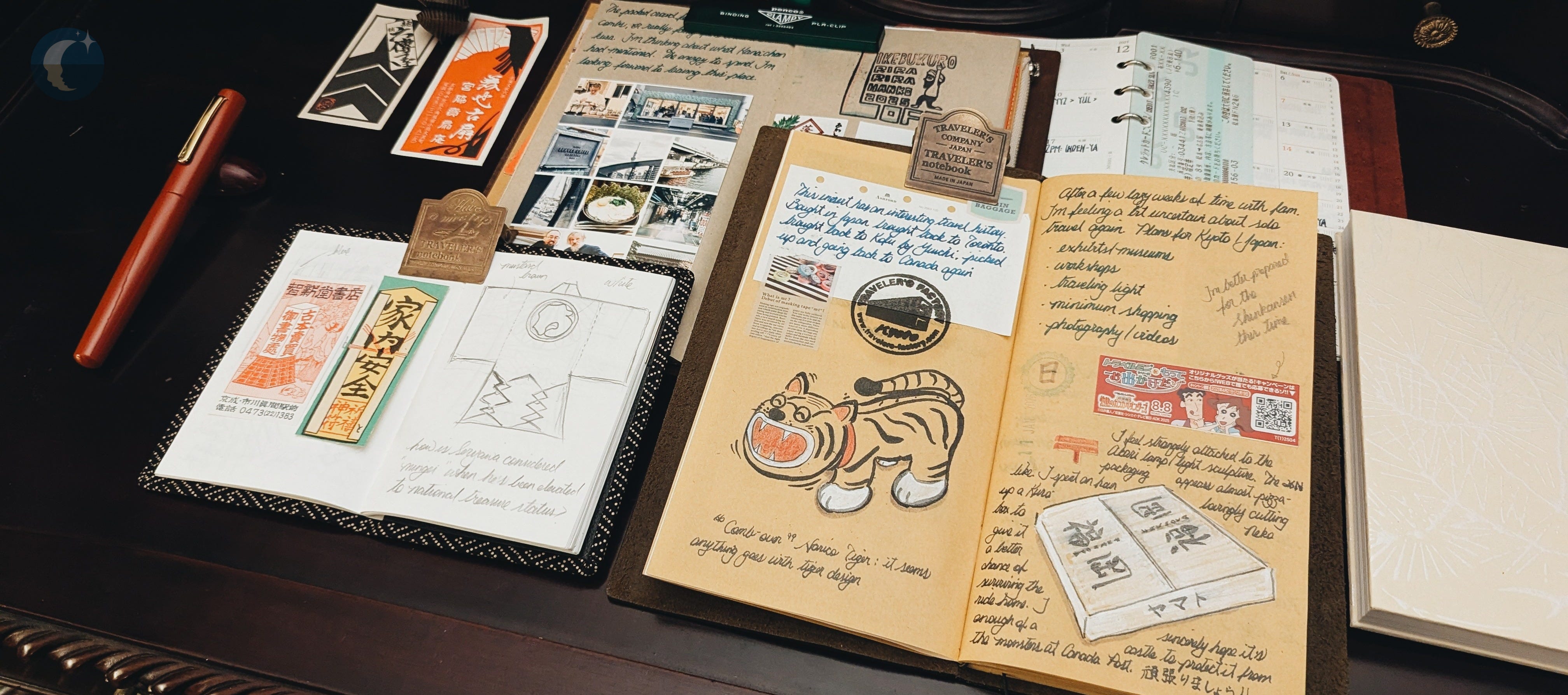
One Person, Four Roles
Saturday, December 13, 2025 at Mokuhankan, Asakusa, Tokyo, Japan.
It was a quiet afternoon at Mokuhankan, David Bull’s woodblock print shop in Asakusa. Several customers were browsing through woodblock prints and deep in conversations with the staff.
After seeing Dave on YouTube for so many years, I was surprised by my own reservation from feeling a bit starstruck. He was lovely: with a vibrant, almost youthful charm, and oh so generous with his time, knowledge and stories.
I initially planned on dropping by to look for prints, and I wasn’t even sure if he was at the shop. Instead, I spent an entire afternoon there, learning about the craft and soaking up the lore.


A lot happened in that short afternoon, and I was so excited that my notes were sparse:
Woodblock prints are not particularly Japanese. The idea existed across cultures over centuries. Ukiyo-e and Hanga stood out as a craft because it was exceptionally refined.
The process is far more collaborative than I had seen in his videos. It’s a division of labour: the designer who conceptualizes and creates the image, the carver who translates it into wood, the printer who brings it to paper, and the publisher who financed and distributed the finished pieces.
We often see the seals of the designer, the publisher and official censors. Despite the collaborative nature, the carver and printers work away from the limelight.
In their heyday, ukiyo-e prints were affordable enough for the ordinary folk. It was never meant to be elevated as fine art. A print might cost roughly the same as a bowl of soba noodles. Hanga was popular, commercial, just like magazines, posters, or illustrated ephemera of today. It’d be difficult to imagine any of the craftspeople believing that centuries later, their work would sit behind glass, protected by climate-controlled systems and admired as cultural treasures.


30,000 Pieces and Still Grasping
Sunday, December 14, 2025 at Hokusai Museum, Tokyo, Japan.
The Hokusai Museum is an impressive building. Lighting is kept at ambient levels to reduce UV exposure to century-old prints. Other than the pen incident when a staff member practically pounced on me, believing I used a non-museum-approved writing instrument, it was uncanny seeing the sheer amount of work Hokusai had produced over his lifetime.


Reflections from revisiting field notes:
Hokusai was famous in the artist circle for illustrating “how to” manga guides for other artists and wagara pattern exploration, which were used for kimono and textiles locally. They went on to be a source of influence for Klimt and Art Nouveau. However, Hokusai is often quoted:
From the age of six I had the habit of sketching things. By the age of fifty I had published a multitude of drawings, but nothing I did before the age of seventy was of any real value.


Grief-stricken from the death of his wife, suffering from poverty for family gambling debts, Hokusai was broke. At age seventy, 36 Views of Mount Fuji was strategic to sell.


At the end of the exhibition. The final diorama was especially poignant on how tough Hokusai was on his craft. There was a life-size Hokusai in his final years: brush in hand, hunched over, with balled-up attempts scattered around him. He was often quoted:
“If heaven had granted me five more years, I could have become a real painter.”
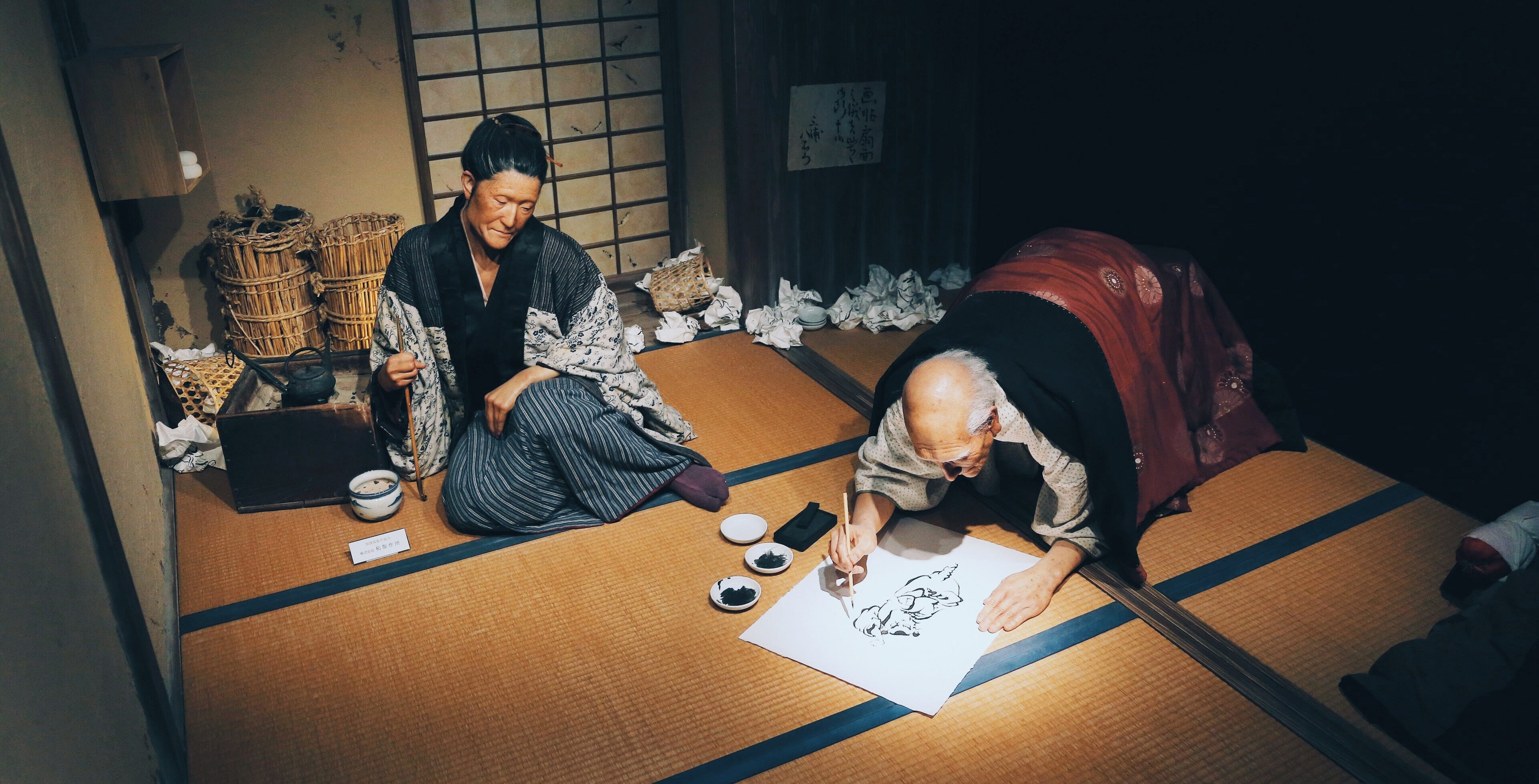
I walked out of the museum with a familiar feeling: despite a massive body of influential work (30,000+ pieces) across vastly different media, he didn’t seem all that contented. I got the feeling that he was not quite done and there is always the allure of that next piece.
Historians can theorize all they want about what he was after. I can’t imagine what it was that he was chasing, but I know the feeling of balling up iterations almost all too well.
A Designer as an Anonymous Custodian
January 13, 2026 at Kyo Karakami Maruni, Kyoto, Japan.
I learned about Maruni in Kyoto when I was researching the history of wagara. They are one of two remaining shops in Japan with century-old woodblocks. Many of them have been lost or destroyed in fires and other calamities. They specialize in hand-printed fusuma or wall decor made the traditional way.
Field Notes:
Large prints are made with a single woodblock, repositioned repeatedly to create patterns.
Due to the fewer number of impressions, magnolia, a softer wood, was used. Ukiyo-e uses a denser yamazakura (Japanese Cherry) to survive a higher print count.
Throughout my time at various museums in Japan, I noticed quite a few locals with a monocular around their neck. I tried to be casual when I inquired what they were looking for; I heard answers from the grain of the wood in famous blocks, blemishes such as a strand of hair documented on famous prints, to the bamboo pad impressions from a certain era. They were looking for the tells to understand the lineage of the print.
At Maruni, some of these woodblocks are so old that they have warped and some unevenly. Despite expert precision to line everything up perfectly, these same signs of craft in the final pattern are prized and appreciated.


For the workshop, I chose a pine needle wagara. Our facilitator Yuko-san helped me understand that pine needles are always in pairs, even when they are old, shed, and fall onto the ground. The pair symbolizes solidarity. It was an easy choice as I was travelling alone.
I’ve been using a Traveler’s Journal to collect goshuin as a record of pilgrimage. Having a dedicated goshuin techo was long overdue. I intended to keep the techo subdued, letting the calligraphy of the monks in the accordion pages do their work. Out of a wide selection of colour options, I opted for a white on white. I was hoping that the mica powder used in the ink would reflect light differently than the textured washi paper.
After the workshop, Yuko-san took us deeper into the shop to learn more about wagara.
The shop prefers to use existing patterns. Although their clients have commissioned new designs, Yuko-san says the most enduring patterns are anonymous. Their beauty and power come from use. The most ideal subject matter is inspired by nature, and they are often misleadingly simple in design.
The opportunity to be hands-on with these museum-worthy woodblocks was already a treat for mere mortals. Yuko-san was all too generous with insight and design philosophy. Previously, I had applied contemporary design thinking to my project while Yuko-san hinted at timelessness, community (no ego), and borrowing from nature.


I was thus able to piece together a semblance of why I had failed in wagara design last year. The task was unlikely to succeed in the hands of a single person. I lacked time and community. It’s all too obvious now. The designer needed for the task wasn’t any single individual but more of an anonymous custodian.
The Pattern Reveals Itself
When I was preparing for this trip, I made sure to have enough notebooks with me to document the adventure along with inspiration and ideas that could come home with me for further exploration. I also wanted to uncover more about the feelings of a creative endeavour beyond the basics of instincts and gut reactions.
In the final few days of the trip, I found myself journaling as if I was settling. I didn’t uncover any clear-cut answers, and I was dismayed that the seemingly simple Ukiyo-e woodblock prints of Hokusai and Hiroshige were much more involved than my original naivety suggested.
Not all was lost. Kataezome found me in one of my final museum visits. My heart raced just thinking about that moment, which I’ll save for the next essay.
On the flight back home, there was one more notebook in my suitcase than I had started with—the goshuin cho from Maruni, made with century-old woodblock. White on white, and the pattern won’t reveal itself unless light hits it in just the right way. Even without a single goshuin, it already feels right. It’s imbued with intention, history, meaning without ever announcing any of it.
✒
Thank you for reading. The Way of the Mirror is a free and reader-supported publication on the beauty of memory-making and journal writing. If you enjoy it, you can support my work with a paid subscription.
Wil
As someone who is exploring printmaking, this post is a gem. I enjoy seeing the nerdism in the name of craft. As a maker, this is like both insight and inspiration. The return to making things by hand has been satisfying to me. I have many ideas that I want to form into something meaningfully tangible and tactile. Thank you for the inspiration.