

Envisioning the End of Our Marriage on Our Wedding Day
Living a vision deeply enough that it stops being the future. This is the story of ours, guided by a traditional Japanese Daruma doll.

My partner's hometown is Fukuoka, Japan. She'd visit her folks quite often. Lucky for me, I'd tagged along as frequently as I could to experience the delicate mix of vibrant modern city life and a very livable, cozy suburb that boasts a rich history and culture. It was always a breath of fresh air, offering inspiration to break away from work and the mundane routines at home.
Discovering the delightful Daruma Doll
On this particular trip, I was in a phase where I was nerding out on some out-of-favour principles, such as tradition and the wabi-sabi (侘び寂び) aesthetic, against the backdrop of tech and innovation, which have been the key driving forces since the advent of the web for the majority of my lifetime.
While soaking up the weekend bustling vibes at the city’s hotspots in Tenjin (天神) and Daimyō (大名), a bank of various-sized Daruma dolls (達磨) caught my eye, pun intended. I was fascinated by these traditional paper-mache dolls at the time for their novelty as a display item while also being rich in symbolism and functional for their intended purpose: to keep us motivated in achieving our goals.
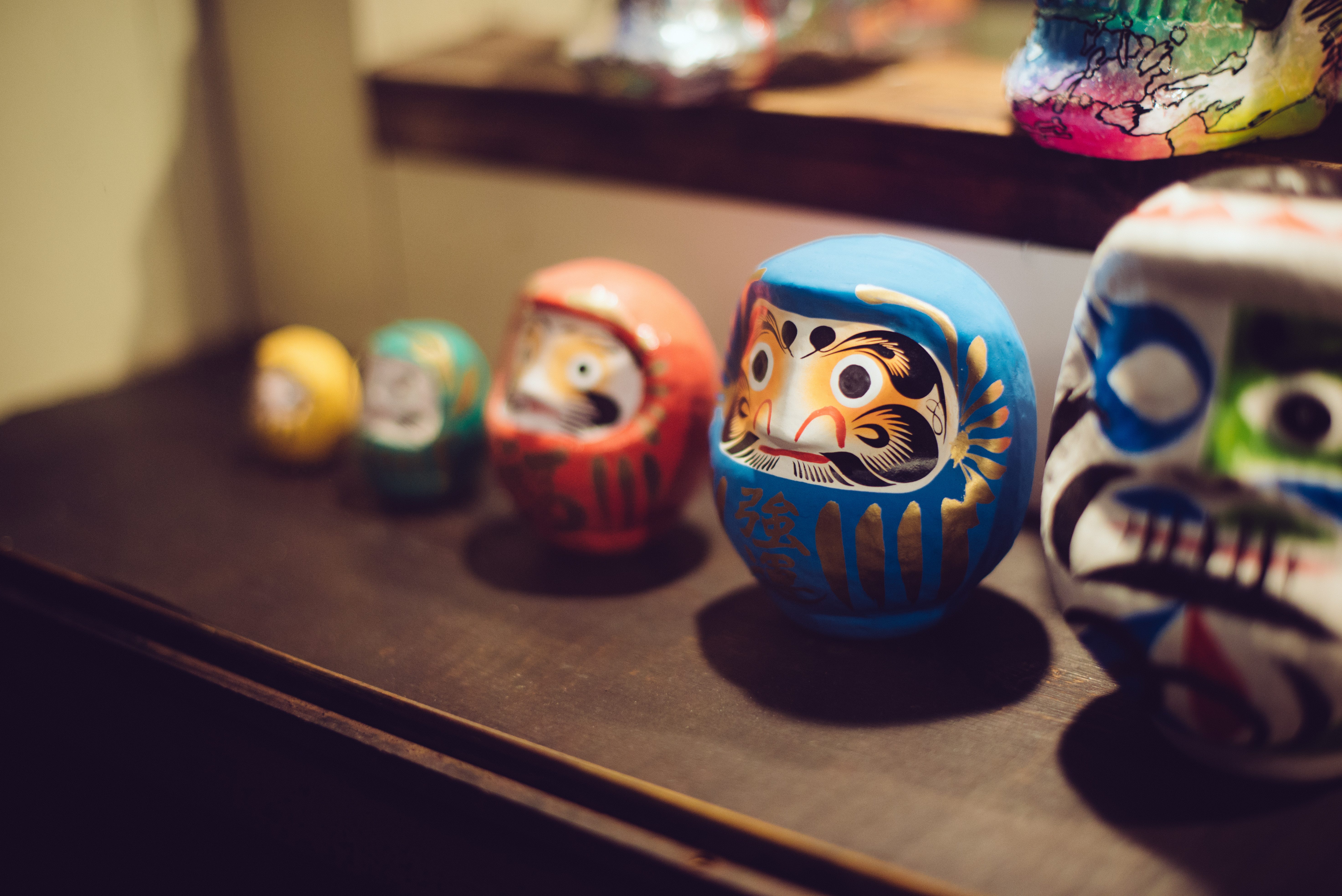
Here's what I love about Daruma dolls:
They are simply delightful. There is a mix of contemporary design, pleasing shapes and traditional brushwork. Being handmade and hand-painted, it's oozing with artisan vibes, as each one is unique with its imperfections.
The doll is based on Bodhidharma, a legendary Buddhist monk with a monster resume - from playing a role in Shaolin Kung Fu (少林功夫) to introducing the Chan/Zen (禅/禪) branch of Buddhism in China and Japan. The popular mindfulness and meditation practice in North America that we know today may have looked very different, or it may not have existed at all if Bodhidharma had not played such a crucial role in its critical path.
It serves a well-meaning purpose. At the time of purchase, the doll's eyes are blank. It's up to the recipient to reflect on a goal that they'd like to overcome and paint one of the eyes (supposedly the left one). I was told that many people set goals related to academic success, overcoming health conditions, successfully completing projects at work, or achieving a particular milestone for business owners.
The one-eyed Daruma doll can then be proudly displayed, serving as a reminder for the goal-setter that they have additional work to do.
Upon success, the right eye is also painted in, symbolizing closure and true insight gained from "seeing things as they actually are," an essential and popular concept from the Zen tradition.
Many believe that the Daruma doll is a talisman of "good luck." I am particularly drawn to the "perseverance, and hard work is required" symbolism that is also intrinsically built into the doll's weighted bottom and roly-poly shape. The self-righting nature symbolizes perseverance and the ability to overcome adversity. Daruma dolls are often accompanied by the phrase "Nanakorobi Yaoki" (七転び八起き), which translates to "seven times down, eight times up."
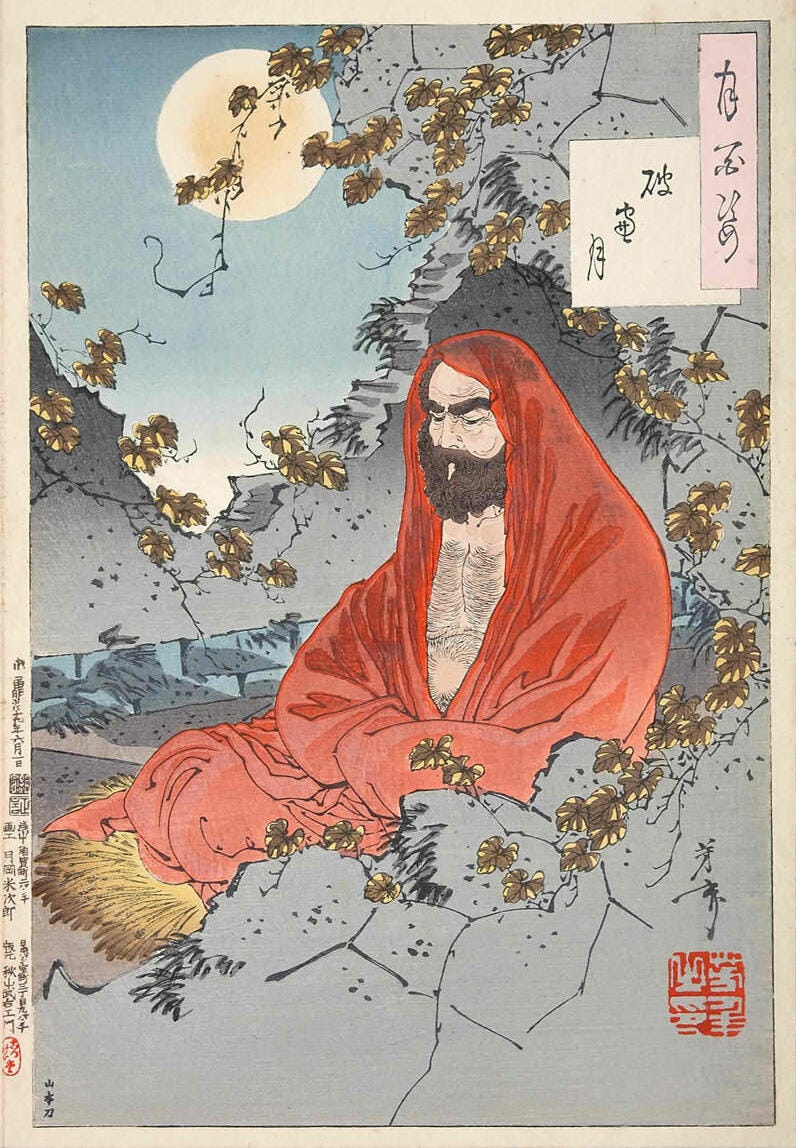
With a shared understanding of the Daruma doll, onward with the story
We ended up picking out a small but respectable-sized Daruma doll in a traditional flat vermilion red colour. As I was strapping on my seatbelt on our return flight home, I recall that it was at this exact moment that I decided on a goal for the Daruma doll. Suppose the fragile doll survives under all that weight in the cargo hold of the plane; the goal I want to set with the Daruma doll is a successful marriage with my partner. She was sitting next to me, hand-in-hand, without a clue that I'd be proposing to her.
Inspiration strikes: A Daruma linoleum stamp
As we prepared for our wedding1, we ended up creating a handful of invitations ourselves. I was intentional about the design as I foreshadowed the presence of our Daruma doll as a part of the ceremony by including a hand-carved stamp of our doll.
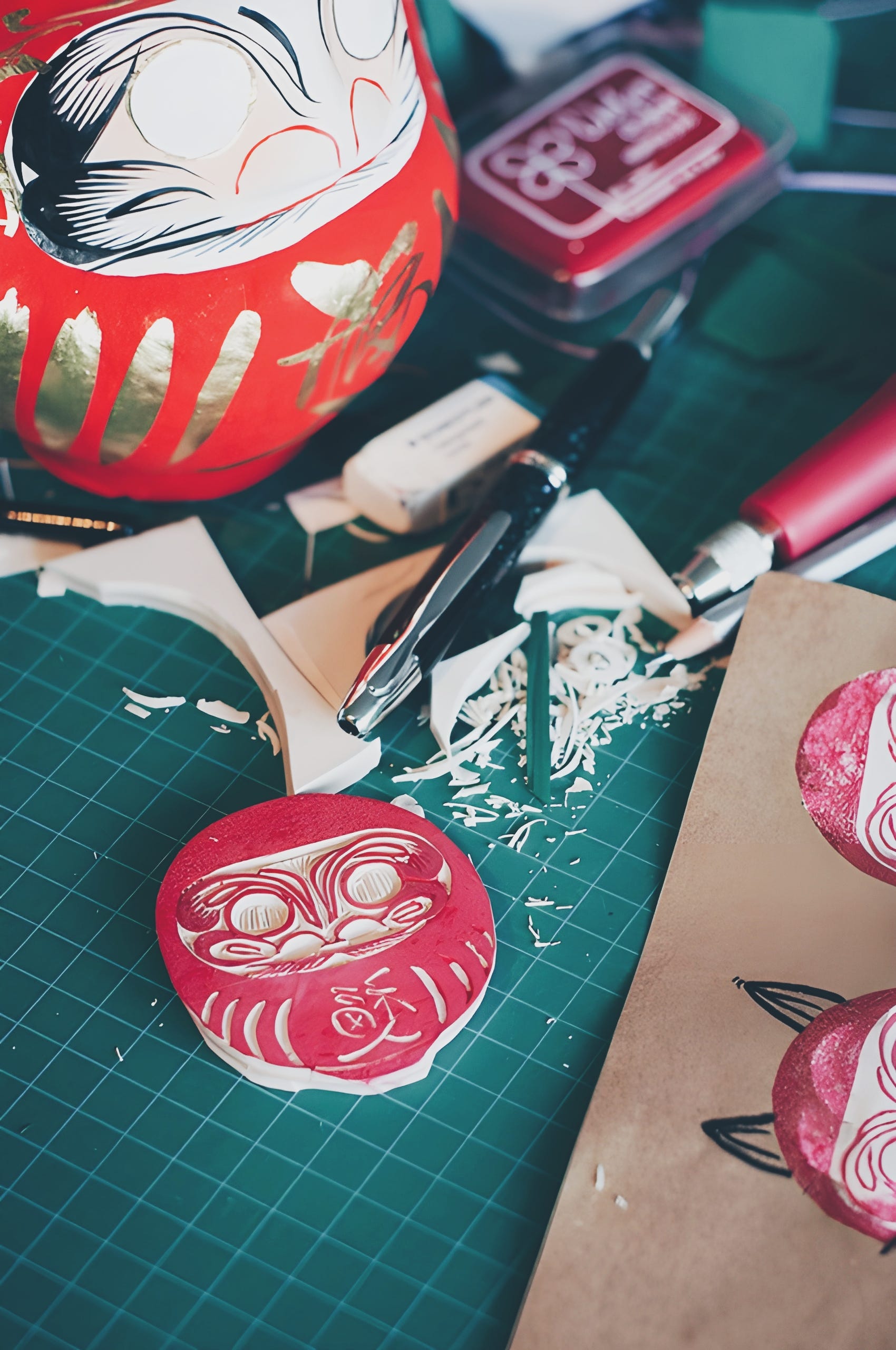
Just like its intended use case, the eyes of the stamp have been left blank. I included instructions for the recipients of the invitation to set a goal should they wish to do so. The invitation with the Daruma stamp would serve double duty, informing the recipient of the event while also serving as a reminder of their goal.
Our Daruma doll graced our ceremony and marked the start of a lifelong vow
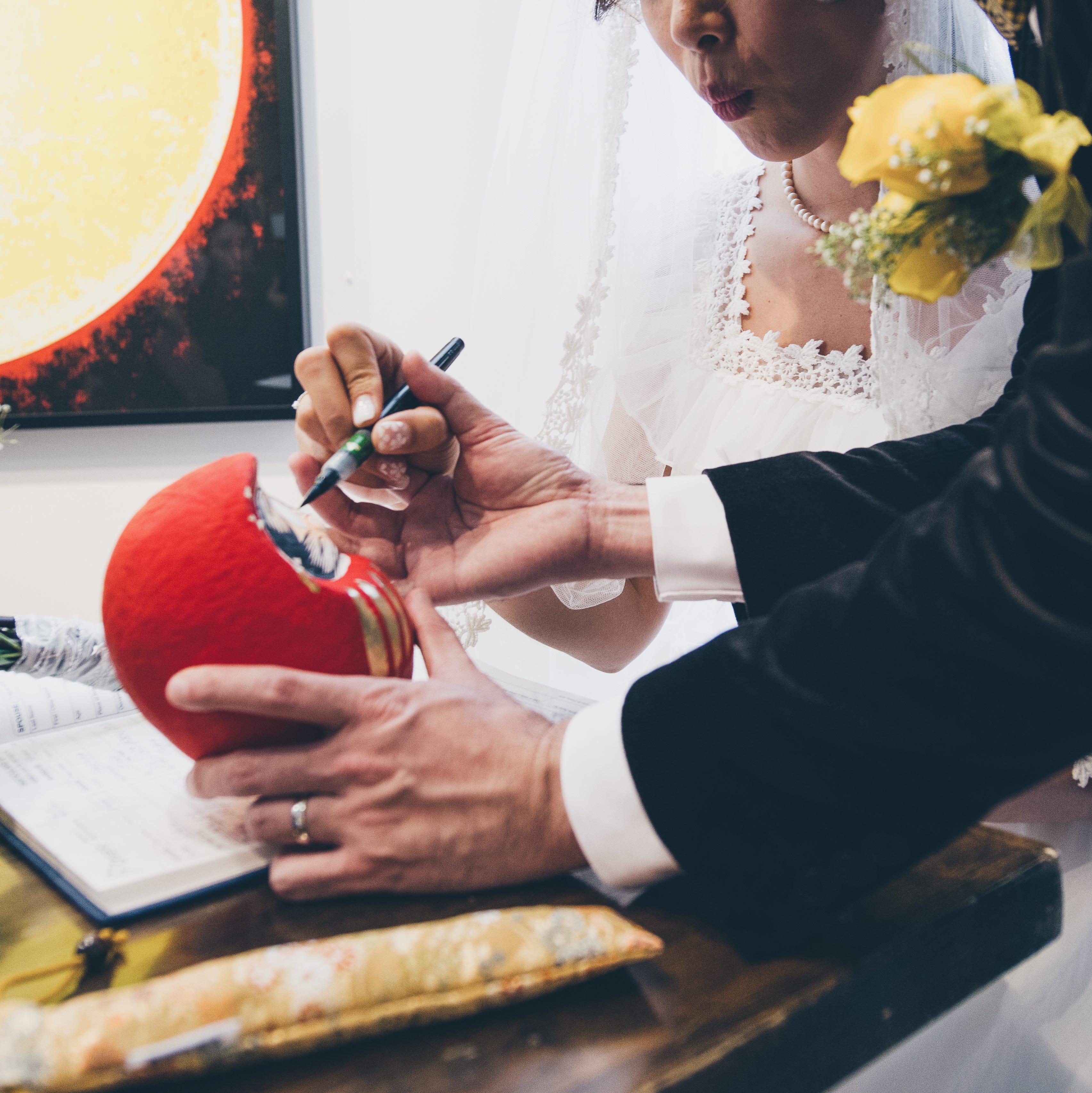
On the day of, the Daruma doll was resting quietly with its blank eyes staring out at our guests. After the official papers were signed, my partner and I proceeded to paint the doll's eye together. We did so silently, almost telepathically, as we shared a goal to honour each other until the end of time.
It was after dotting the eye, when I mindfully placed the Daruma doll back on the table, that I realized my partners's family and friends were laughing at us, "Oh you silly foreigner, it's meant for work and exams—not for marriage." Just mere moments ago, the doll was a lightweight paper-mache object. It has transformed into symbolizing a lifelong goal that we’d work toward for the rest of our lives, remembering, "Death do us part." This may have been the first time that I envisioned how our marriage would end. However, this is where words fail me, as I come face-to-face with my limited ability as a journal writer. The vision is crystal clear in my mind, from the hue of the colours to the scent of an experience that has yet to happen as we are still decades away (I hope). By the end of this piece, I promise to bring this Daruma story to a close. But first, a short diversion.
Our teenage Daruma-san today
The doll now sits majestically on our piano by the stairs (we've since referred to him as Daruma-san2). Each day, he has ample opportunities to single-eye wink at me. Each time, I could almost hear his deep, resonating voice clearly in my head as I winked back at him. "I hear you, and I got you".
The stamp, on the other hand, was forgotten for several years. It only made its way back into our lives when I was decluttering our basement. Since then, it has become a ritual whenever I start a new notebook.
Without fail, I title each notebook cover with an ensō (円相), a circle drawn with a brush. I often follow up with kanji characters that hold meaning for me at the moment. The daruma stamp graces his presence on the bottom corner of the page, frequently skewed to suggest his playfulness in its self-righting nature as I mindfully reflect on goals less lofty than a successful marriage (I've learned my lesson baba, ばば.) I complete this small ritual to fill in his left eye and thank him with a gassho gesture 🙏.
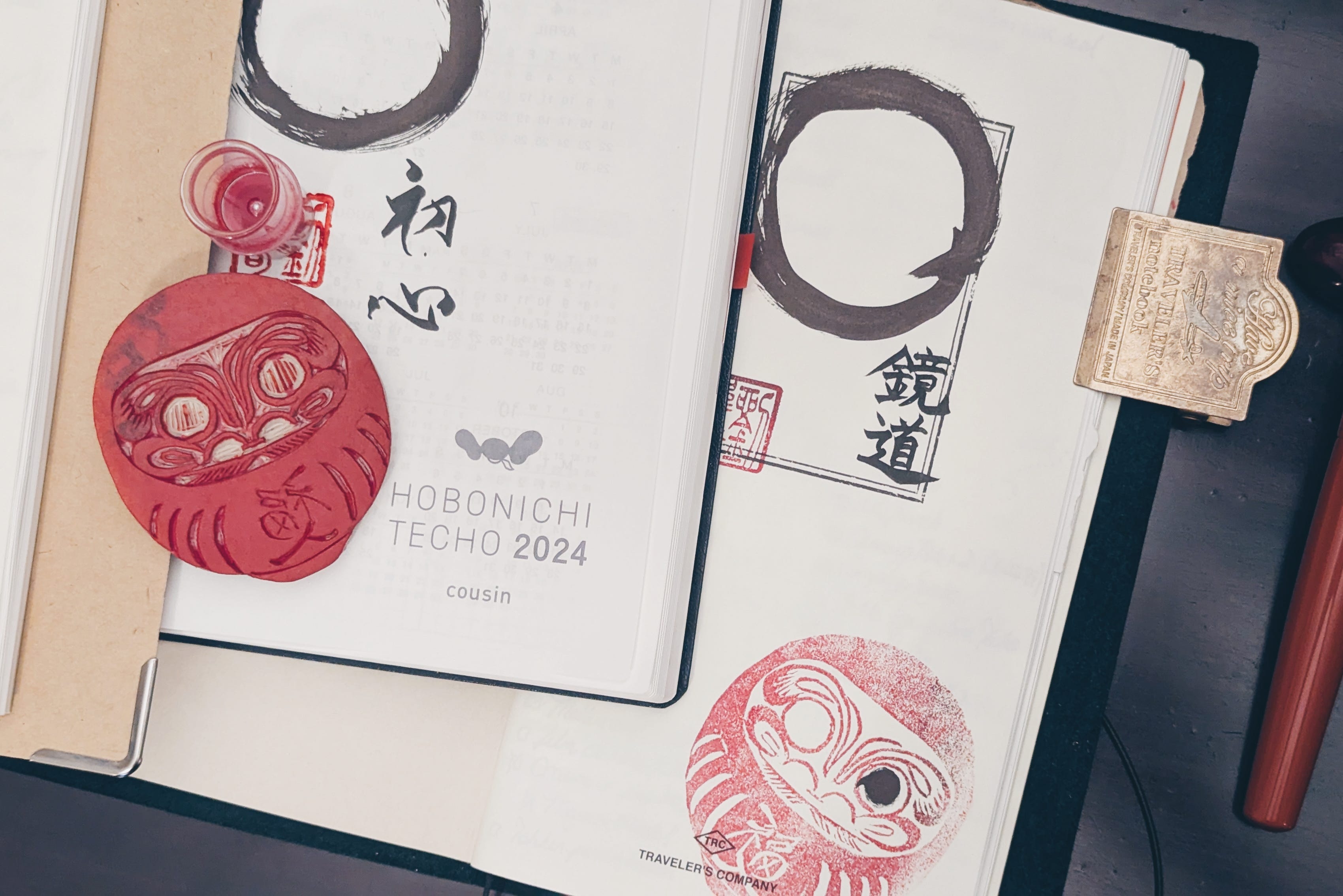
As I near the end of this messy, decade-traversing entry on how I stumbled into the second half of my life with a single-eyed daruma constantly reminding me of my lifelong commitment, I reflect on just how much more work is ahead of me. I've learned that being with someone for a lifetime means many things, and it's not always easy. I've come to learn that adaptability and flexibility, alongside one's partner, are not only underrated but essential. The person whom I painted Daruma-san's left eye with scarcely resembles the same person by my side of today. She has grown, changed, and accomplished a great deal. More importantly, her dreams, outlook and goals have also evolved, as have mine.
My partner has not thought much of Daruma-san in quite some time. I pointed in the general direction of our doll and asked her, "Are we good?" She casually nods, and my mind is instantly transported—as if a Makoto Shinkai soundtrack swells while the camera tilts up toward a vast blue sky.
Envisioning the last day of our marriage
It's around the year 2065.
My breathing is slow, and it's with effort as I lie peacefully in a hospital bed. The walls of the room are painted in a unique hue reminiscent of the flat, dark teal of one of my favourite fountain pen inks3. My partner sits in her chair and produces a weathered but time-honoured Daruma-san from half a century ago with battle scars to show. Somehow, in this vision, our children are nowhere to be seen, not having to own up to these scars when Daruma-san was an abandoned childhood plaything. Just like our wedding day, she places the brush in my hand and guides our hands together to complete the painting of its right eye.

Soon after this, she'll be on a return trip to the temple in Japan with Daruma-san in her carry-on luggage wrapped in furushiki (風呂敷), traditional Japanese wrapping cloths. Daruma-san appears jovial, having completed what we set out to do. He's content in knowing that he's on his return trip to the temple and will be gladly engulfed by flames and turned into ashes.
The Way of the Mirror is a passion project to bring journal writers together. I value transparency and journaling nerdism, from the tools I use to the steps in my writing process4. If this reflection sparked a moment of inspiration or introspection, consider supporting this work by subscribing. It truly means more than you know. Thank you for reading.
Wil
Journal Exercise
In every post, I include context, references, and a writing exercise. I am doing this to help solve one of the top painpoints of journal writing and that is, "what should I write about?"5
Awareness
It was after reading a passage from Erich Fromm's "To Have or To Be?" that I realized I may have been living with a profound psychological and spiritual phenomenon. He posits:
One can also experience the future as if it were the here and now. This occurs when a future state is so fully anticipated in one's own experience that it is only the future "objectively," i.e., in external fact, but not in the subjective experience. This is the nature of genuine utopian thinking (in contrast to utopian daydreaming); it is the basis of genuine faith, which does not need the external realization "in the future" in order to make the experience of it real.
My interpretation is that one could experience a deeply envisioned future as if it were already present, not merely as a fantasy or hope, but as a lived inner reality.
I first caught wind of this phenomenon when I heard my daughter speaking about her future in absolutes. As an aspiring manga artist, she leaves a trail of ever-improving panels, sketches, and character sheets littered around the house. I often see her with a well-worn pencil in hand, huddling over a sketchpad.
She's unwavering. Her thinking, decisions, actions, and speech are completely resolved in this vision of hers. I have come to believe that, subjectively, within my daughter's consciousness, she is already living the reality she anticipates, not by delusion but by deep conviction or inner transformation.
Hypothesis
In both of these examples (envisioning the last day of our marriage and my daughter's conviction in being a manga artist), what links these visions is not the result of blind optimism, nor is it wishful thinking. It is a more passive happenstance over the long term. I suspect this may be the key ingredient that separates the lived inner reality from the utopian daydreaming that Fromm explained. This is the hypothesis that I was exploring:
Can we live in a reality based on a vision that we anticipate with a deep conviction that actually transforms us?
Method
With your journal and writing instrument at the ready:
Consider your future. Do you have certain beliefs about scenarios or events that you have a deep conviction for? Some of these may be so ingrained in your thought process that you may need to really dig in to uncover them. Confining with loved ones or family members may help with revealing blind spots.
Make a list of your personal, deeply envisioned future as a lived inner reality.
From your list, select one that resonates with you at this moment.
Scrutinize and challenge this vision. Ask yourself:
How did this vision come to be?
Is it intrinsic or influenced by someone else?
Now that you are acutely aware of this, do you want to continue or give this up?
For long-running or deeply rooted visions, are there alternatives and better options to consider?
How does this vision make you feel? Unpleasant, ennui or liberation?
Reflect and Write: Take your time writing as much or as little as you'd like about this experience.
Assessment and Insights
When I first encountered Fromm's quote, I was reluctant to explore further as it felt somewhat out of left field. I am glad that I overcame my bias of believing that it was too far on the spiritual side without any science behind his sentiment. However, once I started writing, the list was almost writing itself. I had some deep-seated ideas and assumptions about being a parent, giving up predictable salaried employment to start something on my own, and committing to painting in the right eye of Daruma-san, among others.
I was taken aback by my own insights. A gift-shop novelty souvenir served as a symbol to ground the most important relationship in my lifetime. Each time I see a Daruma, I am reminded of our vows, but only better. It transformed my lifelong commitment to something playful and sentimental. Perhaps I might even find Daruma-san more symbolic than the ring on my hand, as the figure has taken on a personality and narrative of its own.
I am now more aware of the weight and importance that we assign and offload to objects in our lives. I get the sense that my partner appreciates Daruma-san as my conviction has strengthened our marriage and sense of togetherness. Despite not having an instruction manual, Daruma-san is serving and fulfilling its intended purpose triumphantly. I could almost hear him cheering me on, "諦めない!"6
As an aside, there wasn't much preparing to do as the wedding was more of a relaxing hang with a small group of friends and family at a cozy art gallery.
In Japanese, "-san" (さん) is an honorific suffix used after a person's name to show respect.
Taccia Hokusai-sabimidori fountain pen ink: Base colour is a rust-green that may transition to blue as it dries, often exhibiting a rusty red and sometimes copper sheen.
Ideation: A well-worn Blackwing pencil on 2025 Hobonichi HON · Initial Draft: Lamy Dialog on Hohonichi A5 notebook · Revisions: Reworked outline in Logseq and Joplin · Editing: Grammarly, Substack · Photos: Nikon D610 with AF-S FX NIKKOR 50mm f/1.4G, Pixel 7 and VSCO
A daily, recurring topic that surfaces on the subreddit of r/Journaling.
Akiramenai translates to Don’t give up or never give up. It’s often used to express perseverance, determination, or a refusal to surrender, especially in tough or emotionally charged situations. It’s often scream during especially tearful and dramatic moments in sports, anime, or real-life challenges.