

A Desk of One's Own
On solitude and the joy of a thrifted escritoire that saved my journal practice.

It wasn’t supposed to be extraordinary.
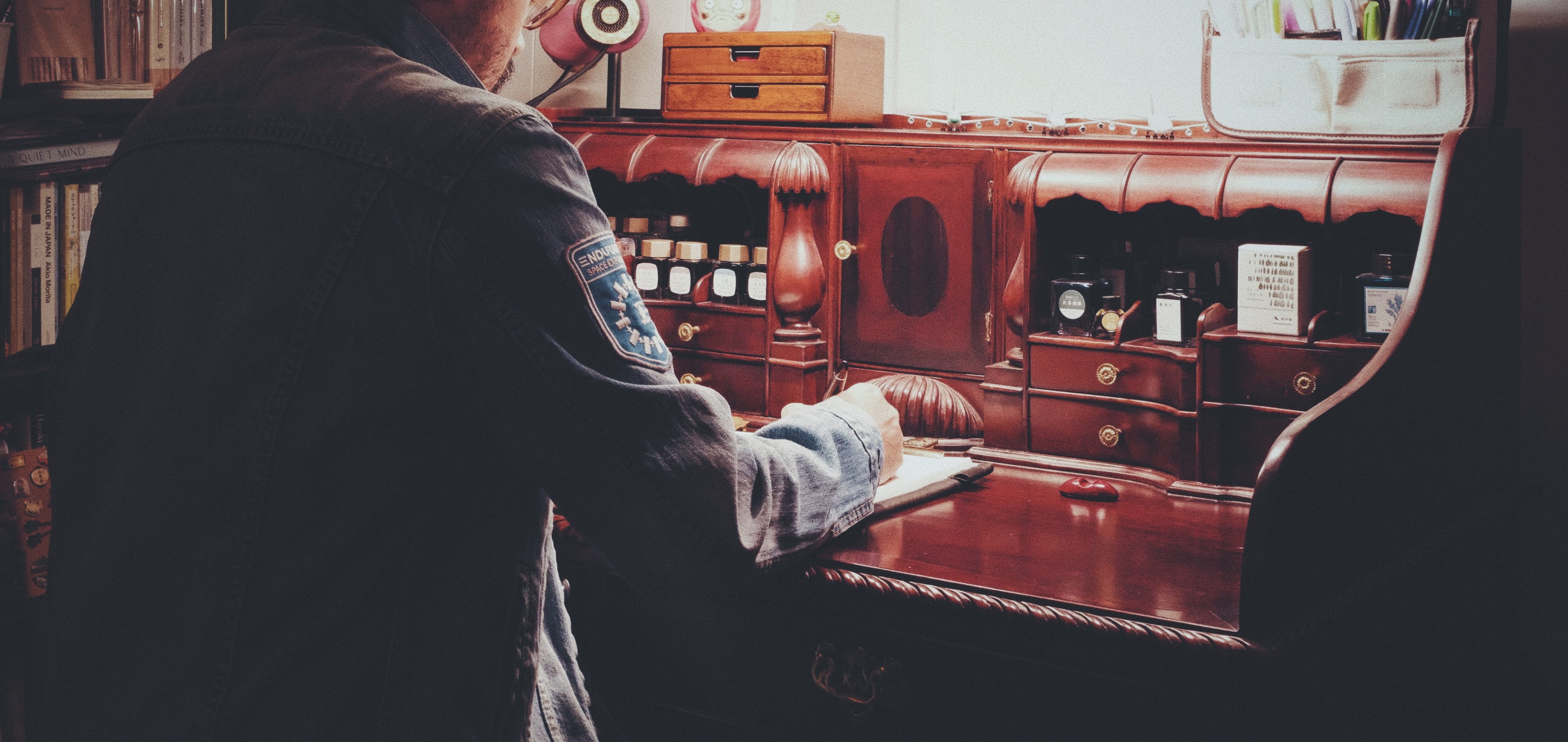
It was just an old desk delivered by a kind gentleman from an online marketplace. The moment I ran my hand over its worn surface and saw dust motes suspended in the light, I felt something I hadn’t felt in a long time: akin to the elation of returning home after a long trip. I never thought a simple, second-hand escritoire could be something I missed so dearly. It was the perfect, yet obsolete, piece of furniture which saved my fragmented journaling practice.
Where We Once Sat Alone
Sociologists worry that we are losing our third place—cafes, barbershops, independent bookstores—the informal shared spaces where we reap the boundless benefits of community.1 While reflecting on lost rituals that make up an unhurried and considered life, I fear we’ve lost another vital space that makes us truly human.
A simple desk, an unconnected desk, a desk without screens or devices. These are the desks that I grew up with. They resemble the same desks once used by some of my favourite authors from an age before the web and connectivity. A once mighty flat surface, not unlike the promise of an empty canvas, offers a private haven for reading, learning, making, and letting idle thoughts and imagination run wild.
As more devices become smarter and connected, they are quickly overtaking our households. The disappearance of the simple desk, once the norm in most homes, means we have one less space where we are truly alone without the buzz, echo, and chatter of the world. All this, in the name of innovation, convenience, and progress.
When are we truly alone? Perhaps only in bathing, bedtime, or solitary moments of gardening, cooking, writing, or walking. For many, even these solitary activities are accompanied by podcasts, videos, and scrolling.
When we lose our simple desks or choose to bring a device along, one of the few remaining places where we have true mental solitude may be lost. We have less and less time to be with our thoughts, for internal dialogue, creativity, incubation, and emotional processing.
Like Thoreau at Walden Pond, seeking the deliberate life in a cabin removed from society’s hum, or Pascal, who warned that all of humanity’s problems stem from our inability to sit quietly in a room alone, these small, unconnected spaces are where new ideas are born and take shape. We risk losing our personal commons altogether, the space of one’s own mind, safe, neutral, contemplative, free from audience and judgement.
For my kids, a desk is where devices go, where we look outwards. I can see them squirm with ennui when there are no devices nearby. They rarely have opportunities to be alone without the chatter of screens, to look inward and appreciate the moments where idle thoughts take flight.
Family Photos, as Contraband — with love from HR
I was having a one-on-one with my friend and colleague. This was a time when I was working in corporate, a publicly traded company.
With a wistful sadness on his face, he told me that HR had approached him that morning. I’ve worked with him for ten years — one of the kindest people I know. I find it endearing and heartbreaking that he often brings challenges that only he would encounter. In other words, I think he gets bullied. He tells me:
“They (HR) told me that I can’t have my family photo on my desk anymore. It was making someone uncomfortable.”
He looked down, dumbfounded, and for the first time since I’ve known him, distraught. His framed family photo was a totem. It gave him strength. I believe he did his best work when he was able to steal glances at it.
I later found the memo from HR, confirming the ban on all personal and family photos.
Our lives outside of work became contraband at the office.
The rest of the meeting was fuzzy. I felt something break inside me as I tried to support a friend whose very reason for working so fiercely had been stripped away. I suspect he wasn’t the only one affected.
I still can’t fathom how a simple posed shot of a family huddled together among fall leaves could trigger a company-wide ban.
It started small at first, then quietly snowballed. The desk, at the office at least, used to be a place full of life, personality, and humanity. I used to look forward to visiting colleagues’ spaces, examining trinkets to learn about who they are. This was a day when we lost agency at our desks, a place where we spend most of our waking lives. Something distinctly human was barred at the entrance of the office towers. Our desks remained, but the motivation to sit at them was gone.
As an epilogue, he discovered a small loophole despite the clampdown on personalization. By swapping out a few image files on his laptop, he was able to steal glances at his family instead of the company logo between application swaps. A minor, nearly invisible act of deviance — a small rebellion against the iron fist of HR.
I learned a new word that day — it’s the reverse of schadenfreude. It’s a very nuanced flavour of envy that must have led someone to report his family photo to HR.
Gluckschmerz is German for the feeling of irritation or pain at the good fortune of others.
A Desk of One’s Own
It was a safe space. It was a creative space.
My childhood desk. I was fortunate enough to have my own desk growing up. Countless hours of joy and elation. Even on lazy afternoons, all I needed was a pencil and some paper. Anything was possible.
Over the years, I had accumulated some treasured stationery that I was not using. They were scattered or hidden away in cabinets and other dark corners. Majestic-looking watercolour pans, cedar incense woodcased pencils, whimsical washi tape, and hand-carved linoleum stamps were calling for my attention as if alive in a Studio Ghibli scene. I sat in front of the screen. I realized my computer desk served one purpose too many. There was much more computer than desk. Something was off.
I disliked the idea of throwing money at problems, but failing at KonMari taught me that journal writing, as both a hobby and passion, warrants the agency to solve this one with a purchase. Keys clacked when I pulled up local marketplaces as I feverishly searched for deals on used writing desks. To my surprise, many owners of these desks were practically giving them away.
The next day, a gentleman was kind enough to deliver his well-used escritoire. I found a small corner in our basement and went around the house collecting all my art supplies and stationery. There was going to be a new home for all of my writing and journaling adventures, and it felt cathartic.
In no time at all, the escritoire became the space that I once had as a child. It was such a fitting outcome. The gentleman reclaimed a bit of space and got some money back for furniture that no longer served. I gave the escritoire new life, and my unused stationery found its place. Once again, a desk of one’s own.
A Gallery of the Thrifted Escritoire:
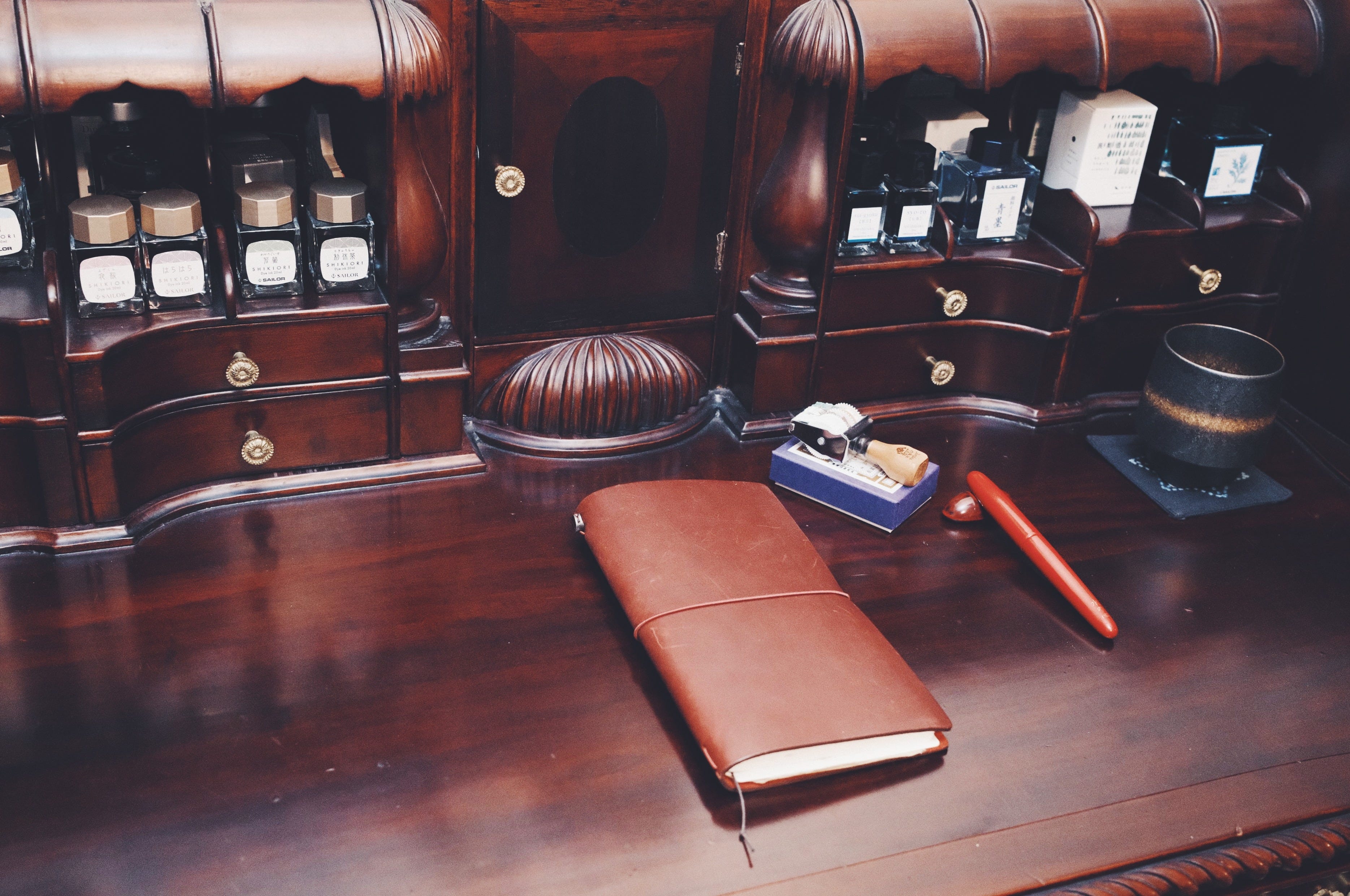
Over time, this thrifted escritoire became more than just a desk. Each drawer, shelf, and compartment gathered memories and curiosities, little artifacts that shaped my journaling practice. Here’s a glimpse:


Upper Shelf: a small exhibit area of keepsakes, collected overtime, rich with memories. Diecast 747 airliners from trips long ago. A two-faced (smiling and raging) daruma rests on top of a small fountain pen collection.

Fountain Pen Inks: When a bottle is almost empty, I pause and give it a small nod of thanks for holding my thoughts so faithfully.


Drawers and Secret Compartments: These architectural, capital-like flourishes are hidden compartments. They remind me of a time when wax seals were used as a form of privacy. They are perfect for stashing away treasured writing instruments and notebooks.


Drawers: stamps, inkpads, washi tape, art materials, wax seals, and a secret stash of exotic woodcased pencils. Keen eye readers may notice a Kakeibo (家計簿) to help me stay accountable. Not pictured are the messier drawers: cleaning and maintenance supplies, sharpeners, stickers, and stamp carving knives.
Together in one spot, they’re easy to see and even easier to use daily.
Having lived with this escritoire for some time, I’ve come to really appreciate it — even depend on it. At first, it felt too indulgent, and the little KonMari in my head agreed. But this unwanted, thrifted escritoire turned out to be luxurious in a way few things are: few seem able to cough up the affordance for a personal, untethered space anymore. It proved its worth and rescued my scattered journaling practice. Over time, it became sacrosanct.
The Razor’s Edge of Remembering
Getting older comes with a lot of surprises. For me, I am seeing the world with two timelines as one simultaneously: memory and present.
Oftentimes, I find my views teetering on a razor’s edge between obsolete irrelevance and quiet insight. It’s easy to be dismissive of old worldviews — in this case, something as mundane as a desk. Younger folks might call me old-school (which I don’t mind; it’s fair and true), but to me, it’s a form of remembering. I knew a world before the web, what it felt like to sit alone at a desk, unobserved and unshared. I want to embrace this private space as part of my contemporary life, without shame for holding such a perspective.
My thrifted escritoire could be your easel, your paint corner, or the path you take on lunchtime walks. They are all one and the same — disconnected sanctuaries for solitude. A relic of the past, yet entirely familiar to me. Aside from sleep, where we spend a third of our lives, I’ve spent more time by choice at a desk than anywhere else. It is a reliquary of my deepest and most sincere thoughts, full of humility, vulnerability, aspirations, and dreams.
As every innovation promises convenience, novelty, and speed, I find myself more hurried and distracted than ever. The web, devices, and generative AI all tug at attention, leaving little room for uninterrupted thought. At this old escritoire, the stakes are clear to me: the ability to sit quietly, to entertain idle thoughts, to incubate ideas, to wrestle with questions with no immediate answers. I don’t pretend to have answers about whether life is better for all this progress, but I do know that losing these sanctuaries would be a loss not just for me, but for anyone hoping to think deeply, understand themselves better, or to cultivate a mind capable of patience, reflection, and wonder.
An Invitation
I often see honest inquiries on r/journaling from inquisitive minds who put themselves out on the web with equally weighted optimism and hesitance, prodding “am I doing this right” or “why is journaling so hard?” In many of the images embedded in these posts, I see keyboards and mice peeking through alongside journal entries.
For a long time, I didn’t know why journaling came easily to me. It feels natural, intrinsic, and on many days, the pen is moving about on the notebook on its own. This essay might offer a small clue, simply by seeing how journaling has evolved over my short lifetime.
When trying a new hobby with a screen nearby, my first inclination is to share results and ask for feedback. Compared with a time when all I could do was (pardon the corporate lexicon) show up every day, over time, I’ve refined my own sense of what I appreciate about my own journals. Our palette will refine over time, and before I know it, it’s all happening on its own.
In our journal practice, we’ve made countless decisions and self-curated our own aesthetics, contents, style, and format to eventually arrive at something we call our own. There may come a time when, as we write each day, or re-read past entries, we may find ourselves asking some honest but difficult questions:
Who am I writing for?
Which part of this am I enjoying most?
If anything, what will all of these notebooks amount to when I am gone?
And now, from our desks, we can ask, share, and get new ideas in mere moments. I am not prescribing a single approach, only offering the invitation I discovered through the escritoire: a place to meet your passion and yourself on your own terms and with curiosity.
I’ve been apologetic for romanticizing how things used to be. Instead, my love for this thrifted escritoire is an unapologetic way to court writers and artists, offering a space that nurtures craft. There are treasures to be found. I wish you luck in discovering “a desk of one’s own”.
✒︎
Thank you for reading. If this resonated, consider subscribing for future essays and practices.
Wil
Footnote: Ray Oldenburg, The Great Good Place: Cafés, Coffee Shops, Bookstores, Bars, Hair Salons, and Other Hangouts at the Heart of a Community (New York: Marlowe & Company, 1999), 16.
I treasure all my workspaces over the years. From childhood till today, my desks had morphed according to how my life shifted and the spaces I inhabited.
It's been where I wrote stories, crafted handmade jewellery and felted goods, drew, carved linoleum for prints, worked on an old typewriter to the laptop and iPad, to numerous notebooks, sketchbooks and diaries. It's where my stationery and art supplies, books, and even camera gears are within reach.
It's the most important space in my entire home. The first I planned for before the bedroom and the kitchen, whenever I move places. Because it's where I spent most of my time in when I'm home.
Indeed, I think we need to actively create that space, and make conscious efforts to have it - or it is nearly impossible to experience the empty mind.
It's funny that in earlier times the phrase "an idle mind is the devil's workshop" was used. Ignoring the oppression and religious tool that phrase was - I can see why it's no longer touted: An idle mind is nearly impossible to obtain nowadays!
I treasure my makerspace. It's a cheap IKEA table, yet it harbours so much potential and is like a warm hug every time I sit in front of it and turn the lights on.